How to find in-market buyers, not just in-market accounts
Most ABM platforms stop at the logo. Here's how to prioritize the people inside an account, so Marketing and Sales know where to focus and why it's worth acting now.

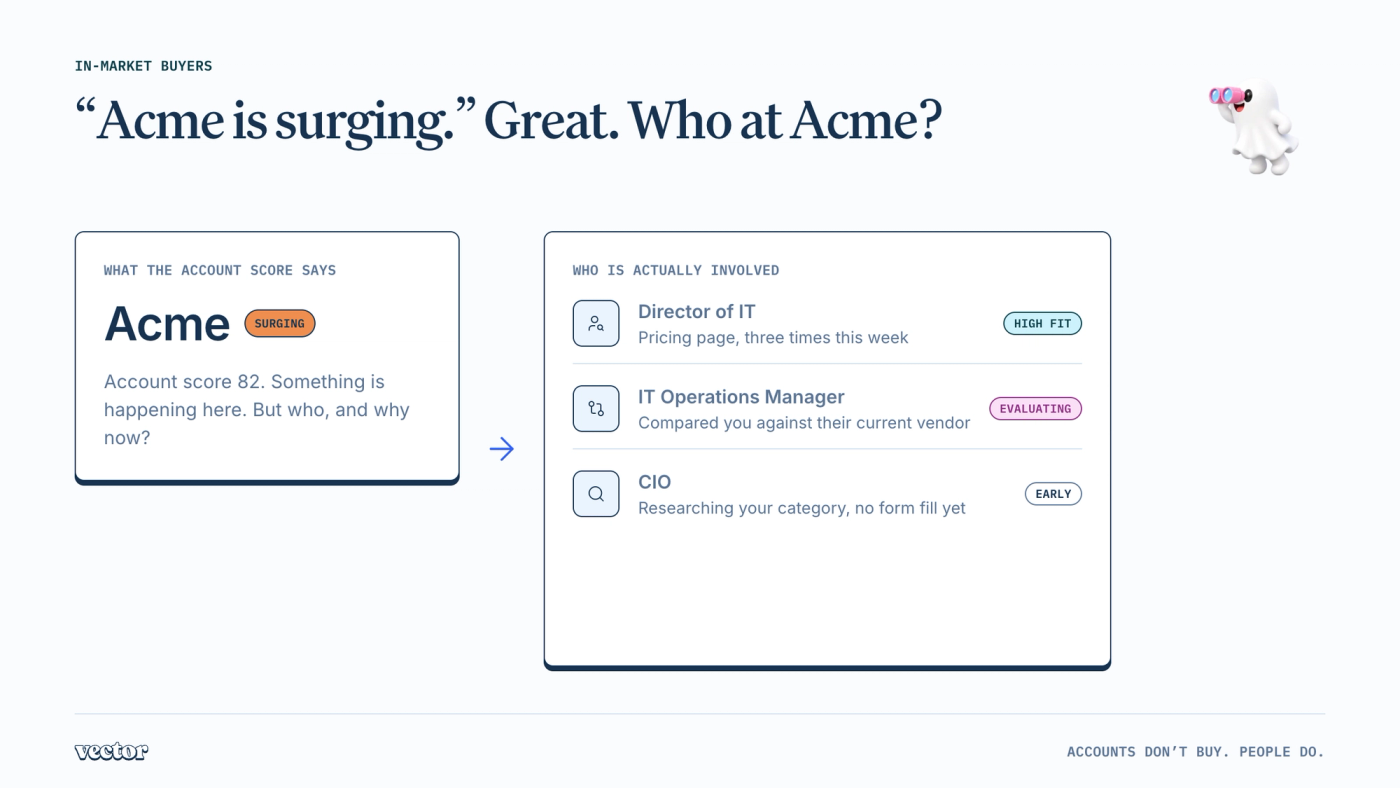
“Acme is surging.”
Great. Who at Acme?
Every ABM platform will tell you a company is interested. For a lot of teams, that’s still where the product stops. An account lights up, Sales gets an alert, and a rep opens LinkedIn and starts guessing.
Guessing looks like calling the VP whose name has been in the CRM since 2023. It looks like sequencing every director with “IT” in their title. Or it looks like waiting for a form fill that never comes.
Meanwhile, the Director of IT who hit your pricing page three times this week never hears from you.
If that sounds familiar, you’re in good company. In our Reality of ABM survey(opens in a new tab) of 239 ABM marketers, one in six said knowing which accounts to prioritize is their biggest ABM bottleneck. That’s… step one. And 81.6% said they can’t consistently explain why an account’s stage or score changed.
So marketing hands Sales a list of “hot” accounts nobody can explain. Sales (reasonably) ignores it. Everyone goes back to waiting for the form fill.
Accounts don’t buy. People do. Your prioritization should work the same way.
The account is where prioritization starts, not where it ends
An account score answers one question: is something happening here?
Before anyone acts, your team needs three more answers. Who’s involved? What are they weighing? And why is it worth reaching out now instead of next quarter?
Vector ties fit and buying signals(opens in a new tab) to the people at each account. You see who’s engaging, their role, what they looked at, what they’re researching, and when they came back.
Now the question changes. You’re no longer asking “Is Acme interested?” You’re asking “Should Acme’s Director of IT hear from us this week?”
A rep can answer that.
Not every visit is a buying signal
A student reading your blog isn’t a buyer. A Director of IT at a target account who has hit your pricing page three times in a week might be. So might the IT operations manager comparing you against their current vendor, or the CIO researching your category before they’ve ever filled out a form.
Vector weighs four things together:
- Fit: Is this the right company, and the right role inside it?
- Behavior: Did they read a blog post, or compare pricing tiers?
- Recency: Was it this week, or last spring?
- Buying-group activity: Is it one curious person, or three people from the same team?
Accounts move through stages as that activity builds, and you can see exactly what moved them.
That’s the difference between “this account scored 82” and “Acme’s Director of IT hit your pricing page three times this week, and a teammate compared you against their current vendor on Thursday.” One you take on faith. The other you can act on.
The more signals you can see, the easier that gets. In our survey, 60% of teams tracking 10 or more buyer signals trusted their scoring enough to act on it. For teams tracking one to three, it was 17.5%.
Give the rep the reason, not just the name
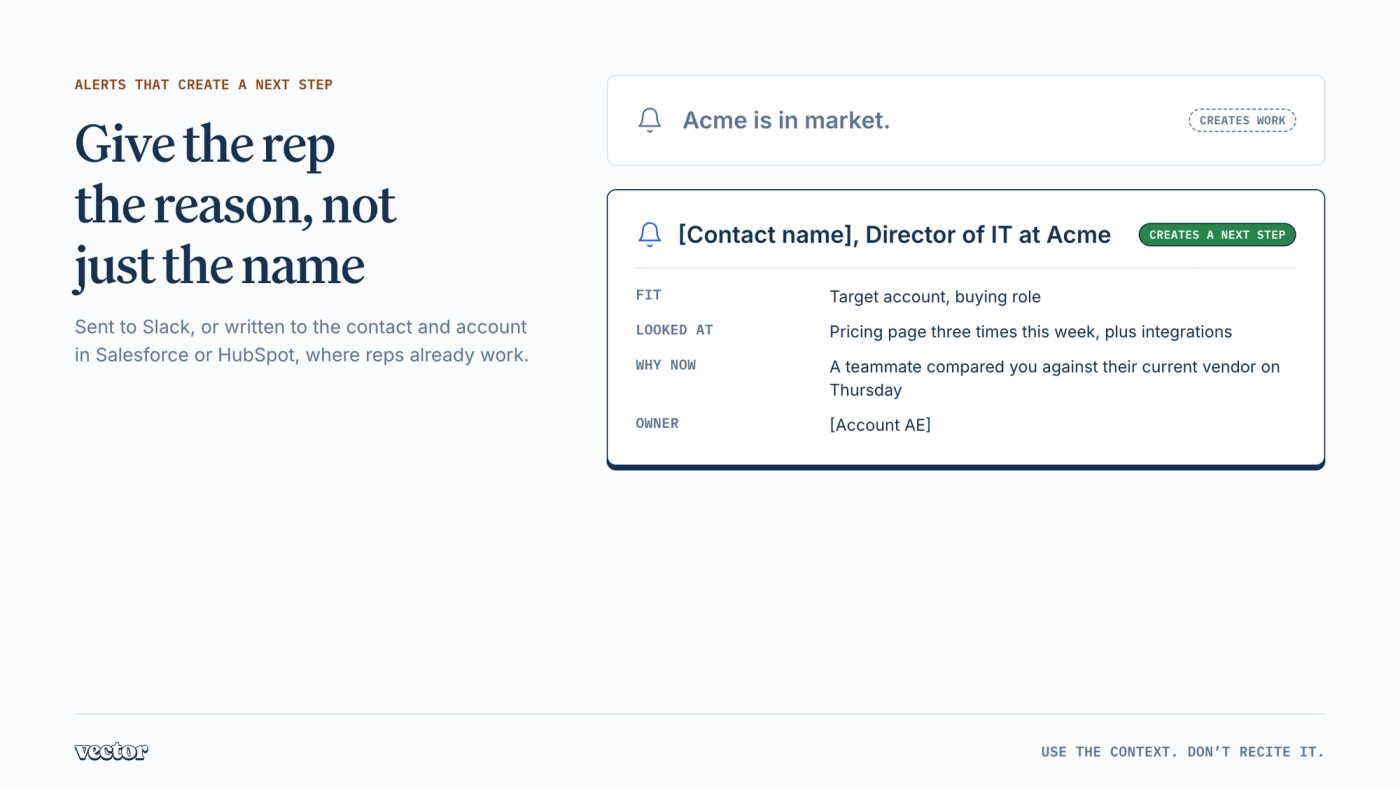
An alert that says “Acme is in market” creates work. Someone still has to figure out who to contact and what to say.
An alert that names the person, their role, what they looked at, and why it matters creates a next step. Vector can send that alert to Slack, or put the activity right on the contact or account in Salesforce or HubSpot, so it shows up where reps already work.
Timing matters as much as the name. In our survey, 92.5% of marketers said they don’t get a real-time or automatic response to buyer activity. A signal that sits in a dashboard for a week isn’t a signal anymore. It’s history.
The rep still decides what to do. But now they’re writing to a real person about a real problem(opens in a new tab), instead of cold-calling a title.
One rule: use the context, don’t recite it. “I saw you on our pricing page” is creepy. “Teams evaluating a switch usually ask about X first” is useful.
Run one play this week
You don’t need a perfect scoring model(opens in a new tab) to start. You need one rule, one owner, and a two-week check-in.
- 1Define fit. Industry, company size, and the roles you actually sell to.
- 2Pick the pages that mean buying. Pricing, comparison, integrations, and case studies. Three to five is plenty.
- 3Set the bar. For example, a fit contact visits one of those pages twice in seven days.
- 4Assign an owner. Usually the account’s AE, or an SDR for unowned accounts.
- 5Review in two weeks. Did reps accept the contacts? Did conversations happen?
If reps keep ignoring an alert, the criteria are wrong, not the reps. Tighten them.
Once the first rule is working, add a second: someone at a tracked account researching a competitor, or a new person from the same buying group showing up for the first time.
What good looks like
More alerts isn’t the goal. Better first conversations is.
Track four things:
- High-fit contacts identified at the accounts you care about
- Sales acceptance: how many of those contacts your reps actually work
- Time from signal to first touch
- Accounts progressing by stage
When those move together, Marketing and Sales are focused on the same accounts, for the same reasons, at the same time. That’s the whole point.
Finding the right people is step one. Next week, we’ll cover what comes after: reaching the rest of the buying committee(opens in a new tab), including the people who haven’t visited your site yet.
Win accounts, person by person.