


We surveyed 239 marketers about the reality of their ABM programs, and one stat really stuck with us:
Only 18.4% said they could almost always explain why an account’s score or buying stage changed.
That’s kind of wild when you think about it. Because scoring is supposed to help you prioritize. But if your platform suddenly tells you an account is “hot,” and nobody can explain what changed, you haven’t really prioritized anything.
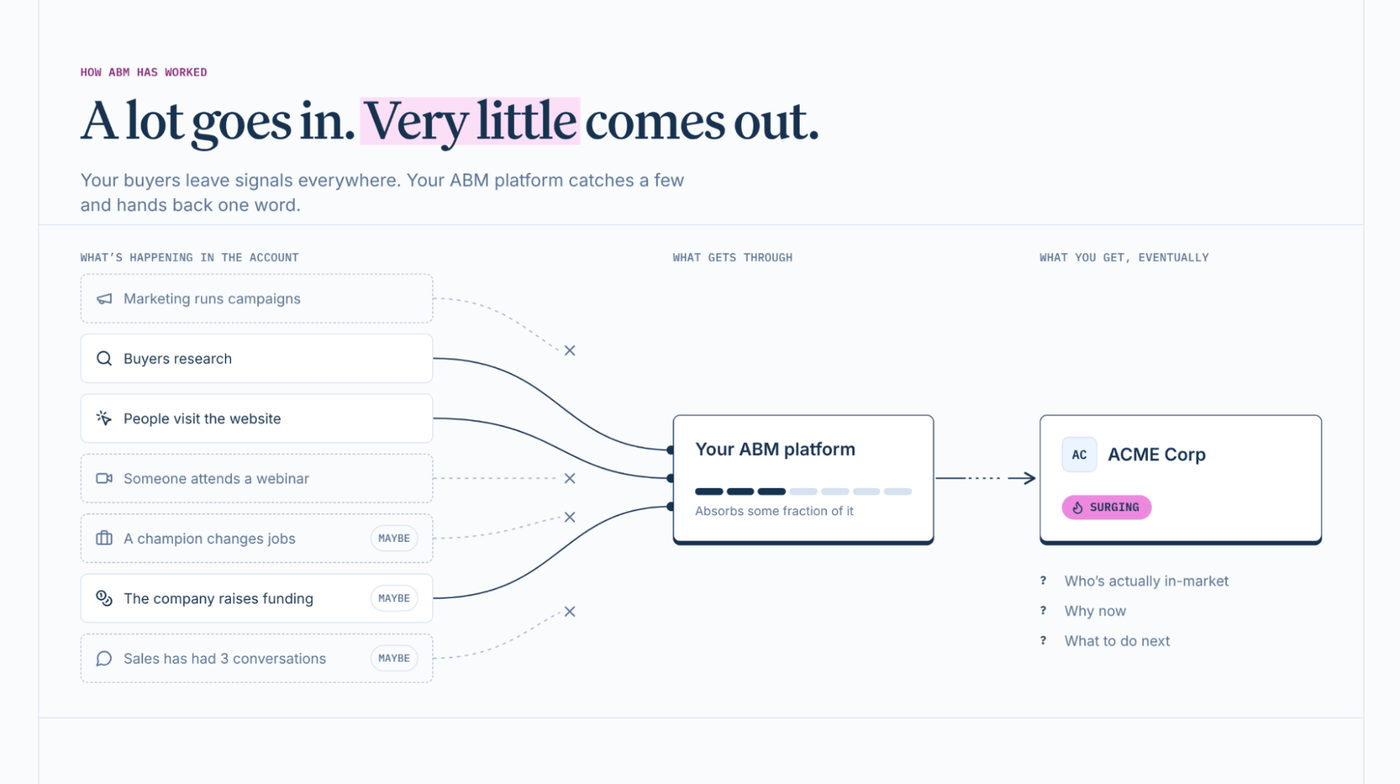
You’ve just created another question. Sales gets the alert. Opens the account. Sees the score. Then:
- Why did this move?
- What actually happened?
- Is this account really buying?
- Who is behind the activity?
- Should I do something about it?
¯\_(ツ)_/¯
That’s the problem we wanted to solve with Vector Scoring.
The problem with scoring isn’t the number. It’s how you got there.
Most account scoring models are built around some version of points.
- Website visit? +5.
- Webinar attendance? +10.
- Pricing page? +15.
- Intent spike? +20.
Eventually, enough activity piles up and the account crosses whatever threshold your team decided means “hot.” There’s a certain comfort in that model because it feels transparent. You chose the points. You chose the threshold. You know the formula.
But the formula only works if buying behavior is that simple. It isn’t.
A CFO visiting your pricing page means something different than an intern doing it. One webinar attendee means something different than four people from the same company engaging over two weeks. Ten outbound emails from your SDR team definitely shouldn’t mean the same thing as a buyer replying to one of them.
And an account with an open opportunity in your CRM isn’t merely “showing intent.” They’re actively evaluating you.
That’s why Vector Scoring is built differently.
Scoring should tell you where an account actually is
Vector Scoring classifies tracked accounts into a buying stage:
Identified → Aware → Interested → Considering → Selecting
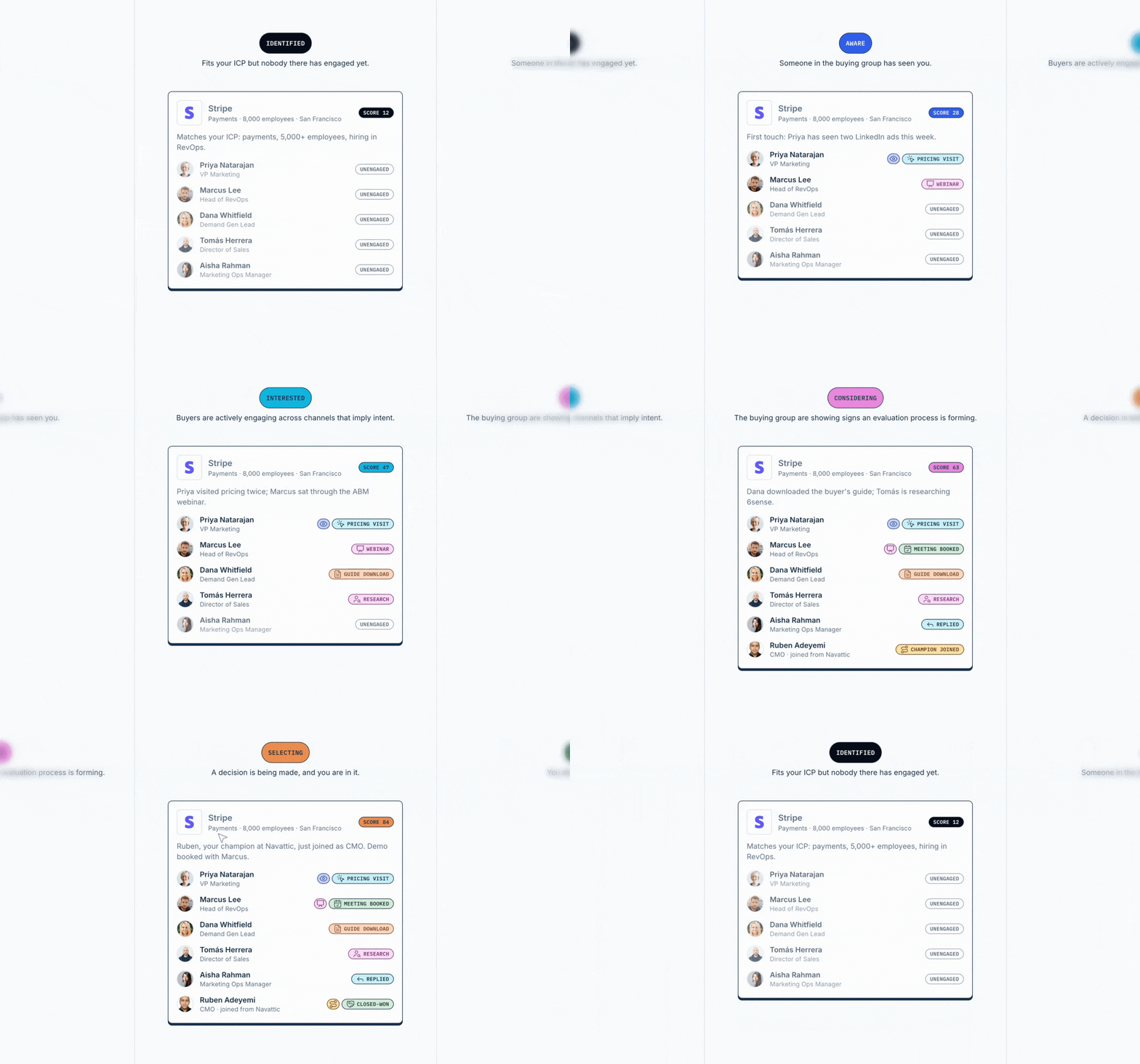
The goal isn’t just to tell you that one account has more activity than another. It’s to help answer a much more useful question:
Where is this account in its buying journey right now?
To make that determination, Vector looks at the evidence across the account: the behaviors, activity, and other signals you’ve chosen to track and evaluate what that combination of evidence suggests.
That matters because no individual signal tells the whole story. A single website visit probably doesn’t mean much. A burst of activity across several people, combined with stronger buyer behavior, might. The stage reflects that context.
And once the stage is determined, Vector assigns a numeric score within that stage. That distinction is important. The number isn’t floating around independently deciding whether an account is interested.
The stage comes first. Then the score helps prioritize accounts within that stage.
An 87 should mean something
Think about how most scoring systems work today. One account has a score of 87. Another has a score of 72.
Cool. What does 87 actually mean?

Is the first account further along in the buying process? Did it simply generate more activity? Was there one very strong signal? Twenty weak ones? You usually have to reverse-engineer the number to find out.
Vector makes the relationship explicit. Scores map to buying stages:
- Identified: 0–19
- Aware: 20–39
- Interested: 40–59
- Considering: 60–79
- Selecting: 80–99
So if an account scores 67, the important part isn’t simply that it has “67 points.” It’s that Vector has classified that account as Considering, and the score helps you understand its priority relative to other accounts in that same stage.
That gives the number an actual job. The stage tells you where the account is. The score helps tell you which accounts deserve attention first.
And sometimes, we don’t need AI to tell us the answer.
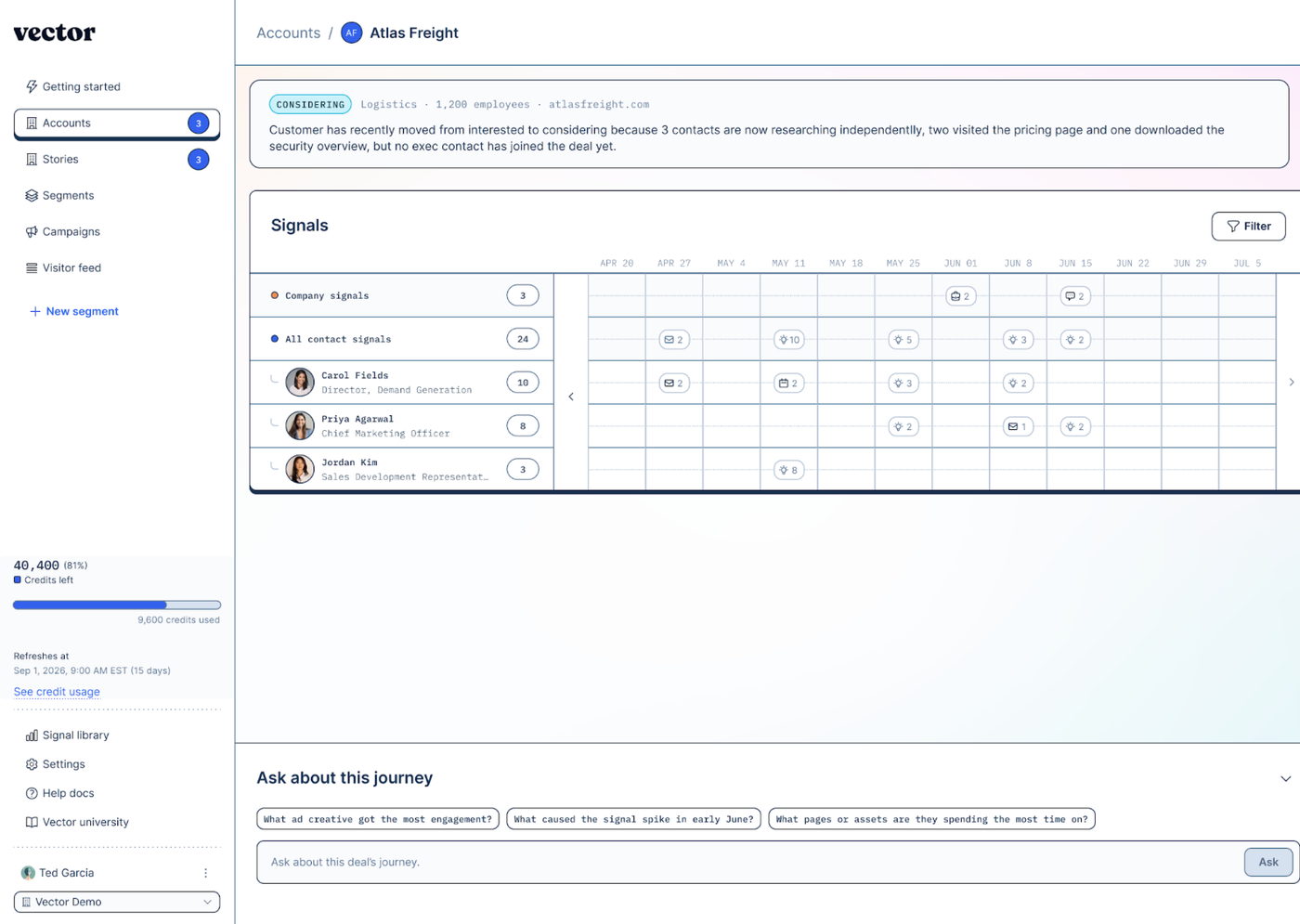
There’s one stage Vector deliberately does not ask the model to predict:
Selecting.
Selecting is driven by CRM truth. If your CRM says there’s an open opportunity, Vector moves that account into the Selecting stage.
Why? Because we already know the account is actively evaluating. There’s no reason to ask a model to infer purchase intent when your sales process has already confirmed it.
This is an important part of how Vector Scoring works. AI is useful when we need to interpret messy buying behavior. It should not override facts we already know.
So if an account has been quietly sitting in Considering and Sales opens an opportunity, the account moves to Selecting because of that CRM event. That transition is deterministic.
The system knows what changed. Your team knows what changed. And nobody has to wonder why the score suddenly jumped.
The same should be true when AI moves the stage
Of course, not every transition is that obvious. Sometimes the buying behavior itself changes.
Maybe an account has been sitting in Aware. Then several people begin engaging. Activity becomes more recent and more meaningful. The pattern starts to look less like casual awareness and more like actual evaluation. Vector may move that account into Interested or Considering.
But the important part is that the stage change doesn’t arrive alone. It comes with the evidence behind it.
Because replacing a mysterious points system with a mysterious AI model wouldn’t actually be progress. If Vector says an account moved, you should be able to understand why.
- What changed?
- Which activity mattered?
- What evidence supported the new stage?
- Was there actually new behavior, or did the explanation simply get reworded?
Vector is designed to preserve that connection between the stage and the evidence used to reach it. If there isn’t new evidence supporting a transition, the account shouldn’t move just because an AI generated a slightly different explanation.
This is what we mean when we say scoring “shows its work”
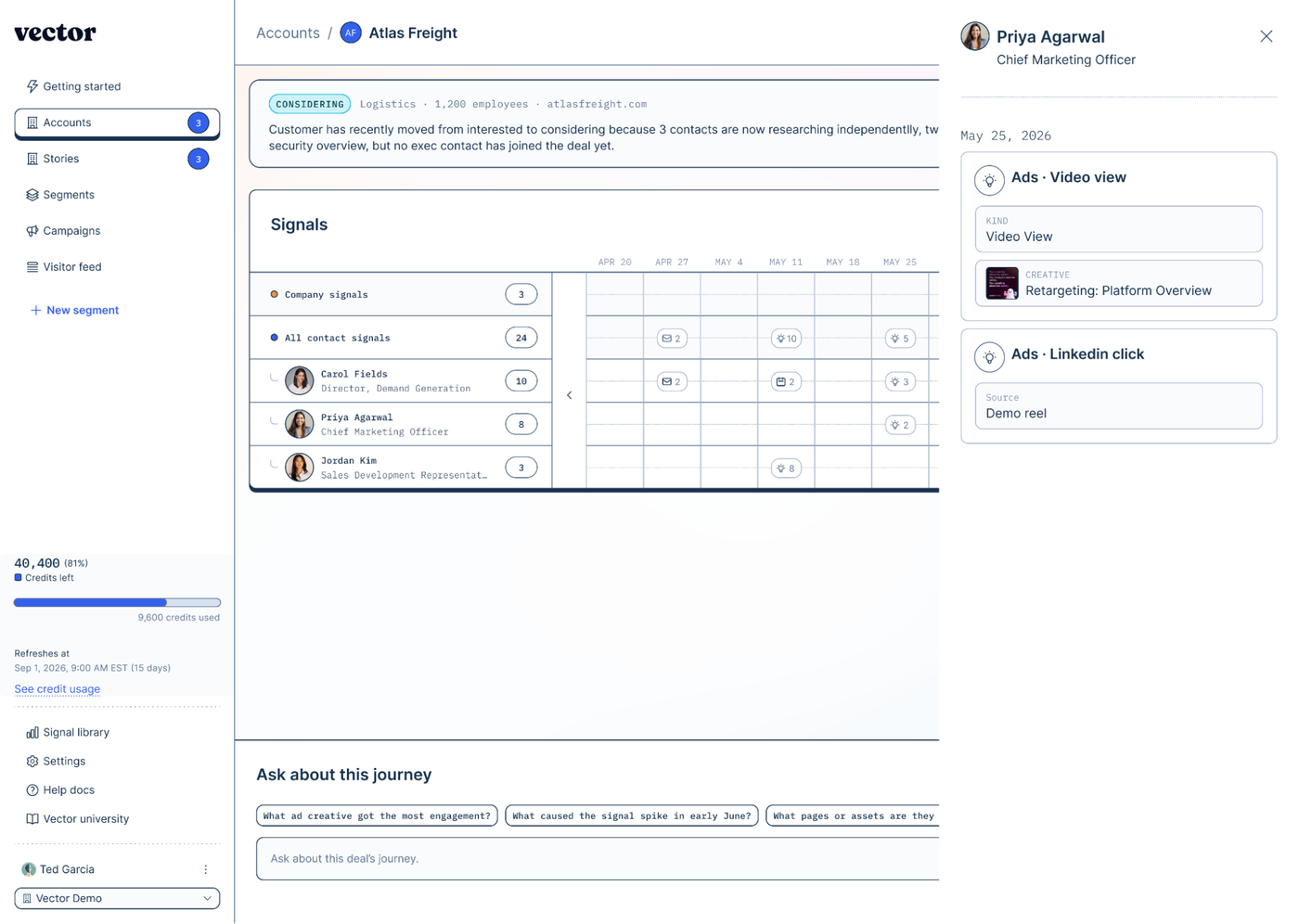
There are really two parts to Vector Scoring. First, Vector evaluates the evidence and determines the account’s buying stage. Then, deterministic math assigns the account a score within that stage based on the strength and density of the activity.
That means the score itself isn’t a random number generated by an LLM. Given the same stage and the same underlying evidence, the numeric result is reproducible.
That matters for engineering reasons, sure. But it also matters for marketers.
Because you shouldn’t have to trust that a black box “just knows” an account is hot. You should be able to trace what happened.
- If an account moves from Interested to Considering, there should be evidence supporting that move.
- If an account moves into Selecting, there should be an open opportunity behind it.
- If two accounts are both Considering but one ranks above the other, there should be a consistent reason for that prioritization.
That’s what explainable scoring should look like.
Not all activity is buyer intent
There’s another reason this matters. A scoring model can only be useful if it understands the difference between your activity and their activity.
If your SDR sends someone 15 emails, that does not suddenly make the account highly interested. Activity generated by your own team shouldn’t be mistaken for buyer behavior.
Vector explicitly guards against that. Outbound activity on its own is down-weighted. Without reciprocal buyer behavior, sending more messages doesn’t magically push an account into Interested or Considering.
Which feels obvious. But scoring systems built primarily around activity volume can easily get this wrong.
More activity does not always equal more intent. The direction and quality of the behavior matters.
Scoring should make the next move clearer
This is ultimately why we built Vector Scoring. The goal isn’t to create a more sophisticated number. It’s to make prioritization more useful.
Instead of:
ACME Corp: 87
you should be able to understand:
ACME Corp is Selecting. There’s an open opportunity in the CRM.
Or:
ACME Corp moved from Interested to Considering. Here’s the new evidence that caused the transition.
And if you have ten accounts sitting in Considering, the score helps you decide which ones deserve attention first.
That gives Marketing something it can actually activate around. It gives Sales context instead of another unexplained alert. And it gives both teams a shared understanding of where the account stands and why.
That’s a much better answer than:
The account is hot.
Because “hot” was never the useful part. Knowing where the account is, why it moved, and what evidence got it there is.