


Someone, somewhere, is paying six figures for an ABM platform and trying to figure out what a sudden spike in "business services" intent is supposed to mean.
Is someone actually shopping? Researching for a presentation? Reading an article? Who knows.
Meanwhile, a former customer just started working at one of their target accounts. Another company announced a major expansion. Three people from the same buying committee have been engaging with marketing.
But sure, let's talk about that intent spike.
For years, ABM platforms have leaned heavily on two types of data: third-party research intent and anonymous website activity. Both are useful. Neither tells you everything you need to know about a buying journey.
And when your whole ABM program depends on a handful of signals, a lot of valuable context gets left out.
That's why we built the Vector Signal Library. It's a place to bring together the activities, behaviors, and company events that actually matter to your business, including signals you define yourself.
Here's what's inside.
First, let's talk about the intent data problem
Traditional intent data has a pretty simple premise: if people at a company are researching topics related to what you sell, that company might be worth your attention.
Fair enough.
But there's a big difference between knowing an account is researching something and knowing which people are interested, why they're interested, and whether the timing makes sense.
And marketers know it.
In our survey of 239 ABM marketers, only 18.4% said they could almost always explain why an account's score or buying stage changed.
That leaves a whole lot of people trying to justify decisions based on information they can't fully explain.
It gets even more frustrating when sales asks the obvious follow-up: "Okay, so what do you want me to do with this?"
That's where having more than one kind of signal comes in handy.
In the same survey, 60% of teams tracking 10 or more buyer signals trusted their scoring enough to act on it. Among teams tracking just one to three signals, that number dropped to 17.5%.
More data doesn't automatically mean better decisions. But having different types of evidence makes it a lot easier to understand what's happening.
Especially when that evidence reflects how your buyers actually behave.
So, what counts as a signal?
Pretty much any meaningful activity or change that helps you understand an account or the people inside it.
Some signals tell you what people are doing. Others tell you what's happening at their company. And some give you a reason to pay attention before anyone has engaged with your brand at all.
Here's a look at what marketers can monitor with Vector.
Research intent: The classic, but make it useful
Yes, Vector has research intent. We're not throwing it out just because it's been around forever.
You can monitor research activity related to topics your buyers care about, including custom intent topics relevant to your business.
The trick is choosing topics that actually mean something.
If you sell cybersecurity software, an account researching SOC 2 compliance might be interesting. An account researching "technology"? Maybe less so.
Research intent can tell you where to look. The rest of your signals help you decide whether there's actually something worth looking at.
Website activity: Who's checking you out?
Someone visits your website. Great.
But are they a potential buyer? An existing customer? Someone who clicked through a marketing email?
Vector's website de-anonymization helps identify visitors where possible, giving marketers more context about the people engaging with their site.
And because website behavior can sit alongside other activity, you can start connecting some dots.
Maybe someone received your newsletter, clicked through to your website, and started exploring.
Instead of treating the email and website visit as two unrelated metrics, you can understand the activity in the context of their broader engagement.
It's the difference between knowing your website had traffic and knowing which buyers are showing interest.
Job changes: Your old champion has a new job
Here's a signal that deserves more attention.
Someone who loved your product moves to a new company.
Or a target account hires a new executive.
Or someone gets promoted into a role that suddenly makes them a much more relevant buyer.
Those are all pretty good reasons to reach out.
Vector monitors job changes, including new hires, promotions, departures, and champion movement.
No mysterious algorithm required to explain why a former customer who just became VP of Marketing at your dream account might be worth a conversation.
Marketing automation: People are engaging. Now what?
Your marketing automation platform is already collecting plenty of information.
Email sends, opens, and clicks. Form fills. Webinar participation.
The problem is that a lot of it gets treated like isolated campaign reporting.
This email got a 4% click-through rate. That webinar generated 200 registrants. Great. But what happened next?
Vector brings supported marketing automation activity into the account picture so you can connect those interactions with other buying signals.
For example, HubSpot marketing email activity and website de-anonymization can help you understand when a contact engages with an email and subsequently visits your website.
A click by itself might not mean much. A click alongside relevant research, website activity, and other engagement? That's worth a closer look.
Sales activity: Because your CRM knows things, too
Marketing isn't the only team collecting signals.
Your CRM knows when meetings get booked, calls happen, emails are exchanged, and deals move between stages.
That information matters when you're trying to understand what's happening across an account.
Vector can bring supported sales activities into the same broader account view as marketing engagement.
So instead of looking at intent data in one tool, campaign activity in another, and CRM records somewhere else, you can connect more of the activity behind an account's journey.
A novel concept: marketing and sales looking at the same evidence.
Company intelligence: What's happening outside your CRM?
Not every buying signal starts with someone interacting with you.
Sometimes the biggest clues come from what's happening inside the company.
Maybe they just raised funding. Maybe they're going through an acquisition. Maybe their latest earnings report mentions a major new initiative.
Vector includes company-level signals for events like:
- Funding announcements
- Acquisition activity
- Earnings reports
- Major company news
None of those automatically means someone is ready to buy.
But they can tell you why a company might have new priorities, new problems, or a new budget.
And that gives marketers something useful to work with.
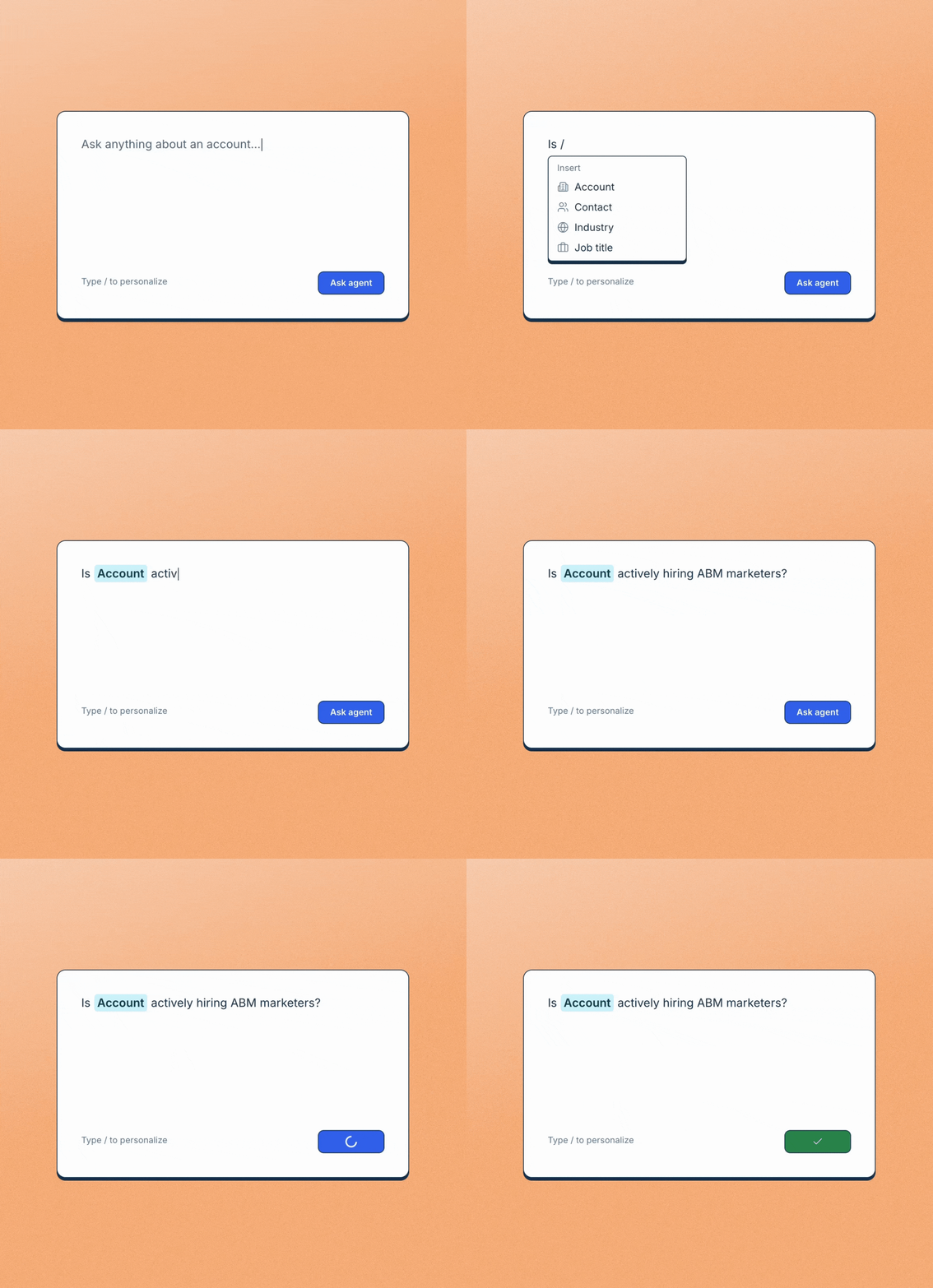
Now for the fun part: You can make your own signals
This is where things get interesting.
Most ABM platforms give you a predefined menu of signals. You pick what sounds relevant and hope it lines up with the way your customers buy.
But what if the best signal for your business isn't on the menu?
What if you're selling to pharmaceutical companies and want to know when one announces a Phase 2 clinical trial?
Or you're selling sales technology and want to spot public evidence that a company might be evaluating alternatives to its current platform?
Or you want to know when a target company starts hiring a particular kind of team?
That's what Vector's custom AI-powered signals are for.
You describe the event you care about, configure the signal, and Vector monitors for relevant company activity.
Some examples:
- Hiring: Is a target account recruiting for a particular role or building a new department?
- Competitive changes: Has a company publicly indicated that it's reviewing its existing technology?
- Earnings calls: Did leadership mention an initiative or challenge your product could help with?
- Industry milestones: Has a pharmaceutical company announced a relevant clinical trial?
- Expansion: Is a company entering a new market or launching a new business line?
These aren't necessarily things a traditional intent provider is looking for.
But if you've spent years selling into a particular market, you probably have a pretty good idea of the events that tend to create opportunities.
Now you can actually monitor for them.
There are some practical limits, of course. Vector can monitor discoverable information, not magically see private contract dates or internal company decisions.
Still, it's a pretty big improvement over having to organize your entire ABM strategy around a handful of generic intent categories.
One signal is interesting. A few together tell you something.
Let's say you're targeting a software company.
It's a great fit, but you haven't seen much activity.
Then a few things happen.
The company announces a new funding round. It starts hiring demand generation roles. Someone who used your product at a previous company joins the marketing team.
A couple of weeks later, a contact attends your webinar and another person starts spending time on your website.
Any one of those signals might be worth noting.
Together, they make a much more interesting story.
There's a potential reason the company might need what you sell, a familiar face in the organization, and actual engagement from people inside the account.
That's a lot more useful than being told an account has an intent score of 87.
And it gives marketing something concrete to bring to sales beyond "the platform says they're hot."
Of course, not every combination of signals means an account is ready to buy. But it gives your team evidence to investigate and a better starting point for deciding what to do next.
Cool, but what actually happens with all these signals?
Good question. Because nobody needs another place to stare at data.
In Vector, the Signal Library controls which activities and events the platform monitors. Those signals can then inform other parts of the ABM motion, including account prioritization, buying stages, account journeys, Account Stories, and activation.
So, for example, you can use signals to understand why an account is showing activity, identify relevant people where their identities are known, and make decisions about which accounts or buyers deserve attention.
And importantly, you can connect that evidence to ways of actually reaching people rather than stopping at an account-level score.
That's the piece that has been missing from a lot of traditional ABM software.
Identifying an interesting account is only the beginning. You still need to understand who matters inside it and what to do about it.
People buy. Accounts don't.
Your buyers are probably giving you more clues than you think
For all the money B2B companies spend on intent data, it's pretty wild how often marketers still have to guess.
Guess why an account moved stages.
Guess whether a signal is meaningful.
Guess which people to engage.
And guess whether any of it will turn into pipeline.
The answer isn't to track every event under the sun. Nobody needs 400 more alerts.
It's to pay attention to the signals that matter for your business, bring them together, and make them useful.
Maybe that's research intent. Maybe it's a new VP of Marketing. Maybe it's an oddly specific company event that would never make it into a traditional ABM platform's signal catalog.
Probably it's a combination.
The point is, you should get to decide.
Your ABM platform shouldn't tell you what matters to your buyers. It should help you find out.