


LinkedIn ads work. Everyone agrees on that.
But the cost of making them work has climbed, while Marketers are stuck watching budgets evaporate without the return to justify the burn.

Let’s face it - you can have the best strategy, the best targeting, the best creatives… but:
- No marketer can be an expert in every channel: Google, LinkedIn, Meta, Display, YouTube, TikTok, Reddit, each with their own constantly shifting rules and auction logic.
- No team can be online 24/7 adjusting bids: Auction volatility doesn’t care about your working hours. Costs spike at 9:12 pm, drop at 3:47 am, then explode on Mondays, only to randomly stabilize on Friday mornings.
- Algorithms change silently and constantly: LinkedIn tweaks something behind the scenes and suddenly your CPC is up 32% “for no reason.”
- The “right” bid changes 100+ times per week: What works today might not work tomorrow.
Humans cannot manually manage LinkedIn bidding at the speed the platform demands.
It’s not a skill issue — it’s a physics issue.
And on the flip side… bid agents have burned marketers.

If dealing with LinkedIn’s volatility is one flavor of pain, bid agents have historically delivered another: betrayal.
Most marketers don’t distrust automation; they distrust how it's been sold to them.
Let’s just say it plainly:
Bid agents have burned a LOT of very smart marketers.
- Black-box optimization: Tools that adjust your bids but never explain why.
- The infamous “spend tax”: 5–15% of ad spend…that mysteriously grows when your budget grows.
- Misaligned success metrics: Tools brag, “Your CPM is down 40%!” Meanwhile, your conversions are down 60%.
- Under-spending that kills momentum: The tool enters two auctions a day “to save money,” then proudly shows you how efficient it was… while tanking your reach.
There’s a reason bid agents often get responses like:
“Oh no, we tried that once.”
“It tanked our performance.”
“It cost a fortune.”
“Never again.”
This isn’t irrational skepticism.
It’s earned skepticism.
Marketers aren’t anti-automation.
They’re anti being blindsided, misled, or charged for value they didn’t define.
So we built a Bid Agent that fixes every one of these problems transparently, predictably, and aligned to how marketers actually measure success.
What Vector Bid Agent actually does (and why it matters)
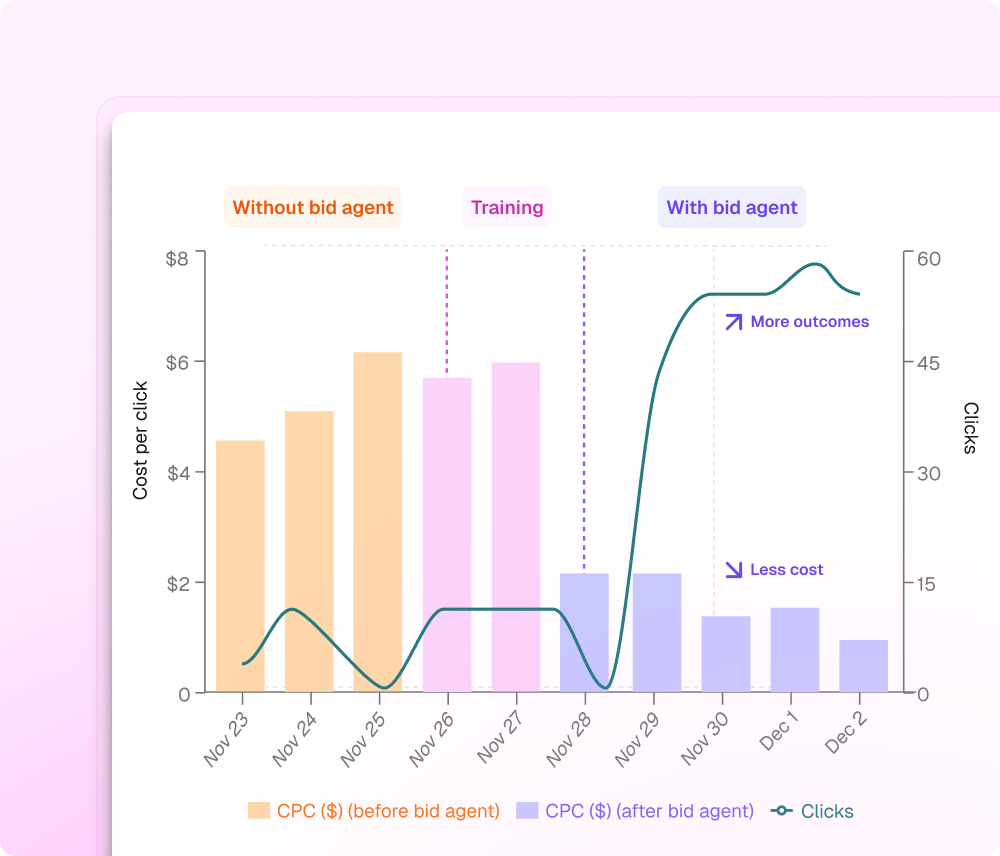
Here’s what Vector’s Bid Agent actually does transparently, predictably, and in direct response to the pains marketers have lived through.
1. Replaces Max Delivery with manual bidding — automatically
Manual bidding is the only way to control when your ads enter auctions. Max Delivery ignores auction quality and prioritizes spend.
Why this matters:
→ It turns LinkedIn bidding from a black box into a controllable system.
→ You stop competing in the most expensive hours and start winning in the most efficient ones.
→ Your performance is dictated by strategy, not platform defaults.
2. Adjusts bids every ≤15 minutes
Auctions shift constantly. Humans can’t keep up. Other bid agents pretend to keep up. Bid Agent actually does.
Why this matters:
→ You capture “cheap but high-intent” windows that were previously invisible.
→ You stop losing auctions simply because the algorithm changed while you were in a meeting.
→ Volatility becomes an advantage instead of a tax.
3. Uses weekly pacing, not daily, because daily pacing kills efficiency
Daily pacing dumps money early in the day and early in the week, right when CPMs spike. Weekly pacing rebalances that in your favor.
Why this matters:
→ You stretch your budget across the windows that actually convert, not the windows where everyone else is overpaying.
→ You avoid Monday budget blowouts and Wednesday mid-week stalls.
→ Your spend matches buyer behavior, not platform pressure.
4. Runs a 3-day learning phase to build a real baseline
Vector is explicit: the first 3 days are observation-only.
Why this matters now:
→ You get optimization tailored to your unique performance curve, not generic rules.
→ No surprises, no “trust us,” no random swings.
→ You always know what the agent is doing and why.
5. Optimizes for outcomes, not “lower spend” or vanity metrics
Most bid agents brag about lowering CPMs. Vector focuses on more results and better efficiency at the same spend.
Why this matters:
→ You have automation that aligns to your definition of success, not its own.
→ Efficiency becomes performance, not austerity.
6. Works WITH your strategy and your agency, not against them
You keep every part of your campaign setup: audiences, creatives, segmentation, ICP logic, measurement, and agency workflows.
Bid Agent only controls bid × time × day. Nothing else.
Why this matters now:
→ No overwrites. No conflicts. No “it changed your campaign overnight.”
→ Your strategy stays intact, it just performs better.
→ Automation elevates your work instead of sabotaging it.
7. Has no “spend tax” and no hidden penalties for success
Bid Agent isn’t priced as a percentage of ad spend. Your budget stays your budget.
Why this matters now:
→ Your success doesn’t cost you more.
→ You’re not punished for growth.
→ Value compounds without a financial catch.
The "so what": Bid Agent compounds the value of Vector
Vector shows you who is in-market and how to reach them.
Bid Agent controls when and how much to pay for that attention.
So what? Your highest-value buyers see your ads when they’re most receptive and cheapest to reach: a combination marketers rarely get.
This is the performance trifecta.
The Lift You Should Expect
- 35%+ lower cost per outcome
- 50%+ more results
- ~2 weeks to meaningful lift
When I should use Bid Agent (marketer’s guide)
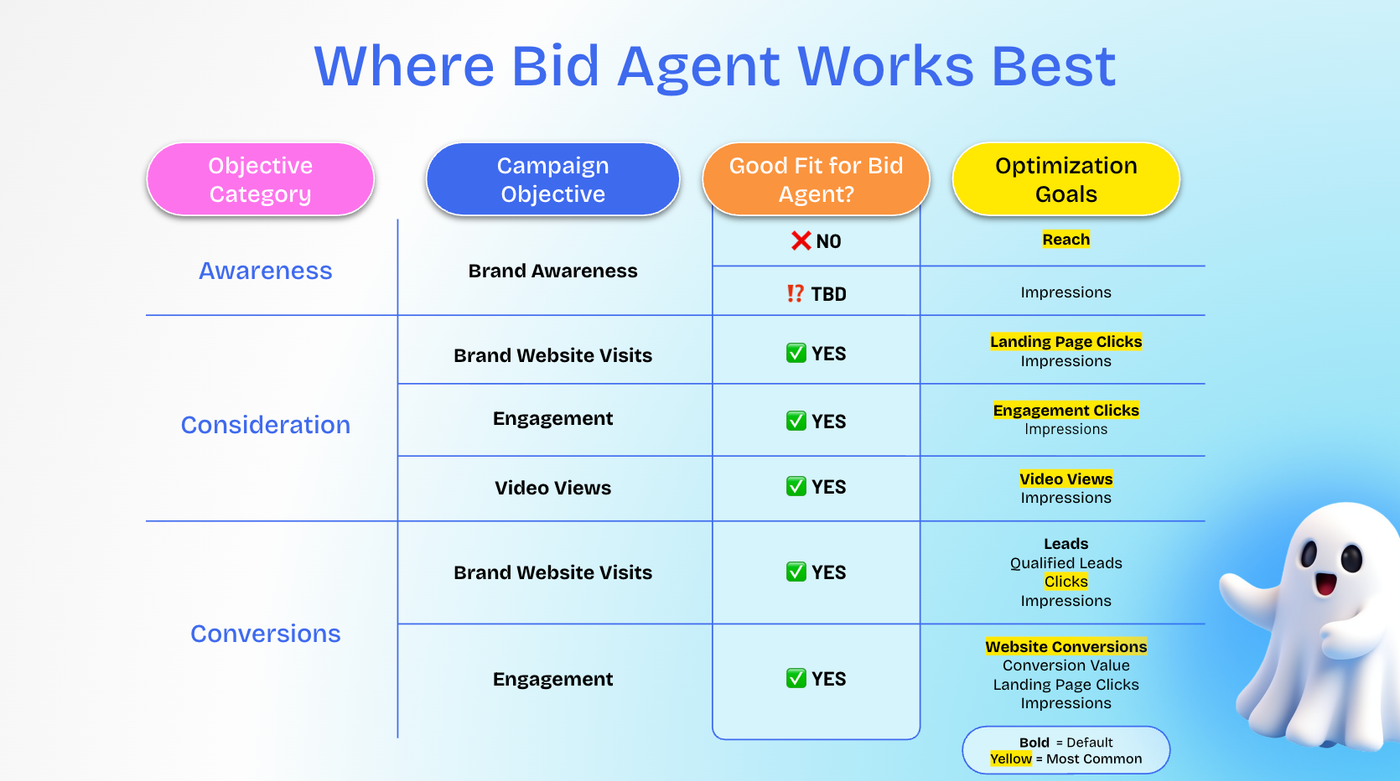
As a marketer, here’s when Bid Agent actually makes a difference for me and why it matters.
Turn on Bid Agent immediately when:
- I need better efficiency on my ad audiences → Bid Agent protects them from cost spikes and volatility.
- I’m running across multiple channels → It removes one major channel from my workload and keeps performance high.
- I don’t have ad ops bandwidth → It covers the 23 hours a day I’m not in the dashboard.
- I’m scaling or launching new campaigns → It stabilizes cost while everything ramps.
- LinkedIn’s targeting frustrates me → I’m hitting the right people — but at the wrong price.
- I’m entering a new region/market → Bid Agent prevents overspend while I figure out what works.
Get your ad audiences activated first, then layer Bid Agent in when:
- I need stronger analytics or ROI clarity → Vector activates the right contacts; Bid Agent amplifies once that's in place.
- My agency is managing the ads → Vector becomes their data layer; Bid Agent becomes the performance boost later.
- I'm getting early in-market signals but haven't activated ads yet → Vector activates those contacts; Bid Agent makes each impression more efficient.
- I'm coming from 6sense / Demandbase / legacy ABM → Vector is the bridge; Bid Agent is the multiplier once we've transitioned.
✨ The marketer’s bottom line
Bid Agent isn’t step one, it’s the efficiency accelerator that makes campaigns cheaper, more stable, and more predictable after I’ve set the right foundation.
When volatility is the hidden cost driver (which is almost always), Bid Agent is what flips performance in my favor.