

Workbar, a Boston-based coworking brand with 11 locations, was done wasting budget on broad audiences and lookalikes. They wanted to know exactly who was on their site, who was clicking their ads (even if they didn’t convert), and how to act on those signals without breaking what already worked.
Vector gave Workbar contact-level visibility and timing so ads, outreach, and follow-ups all happen when interest is real.
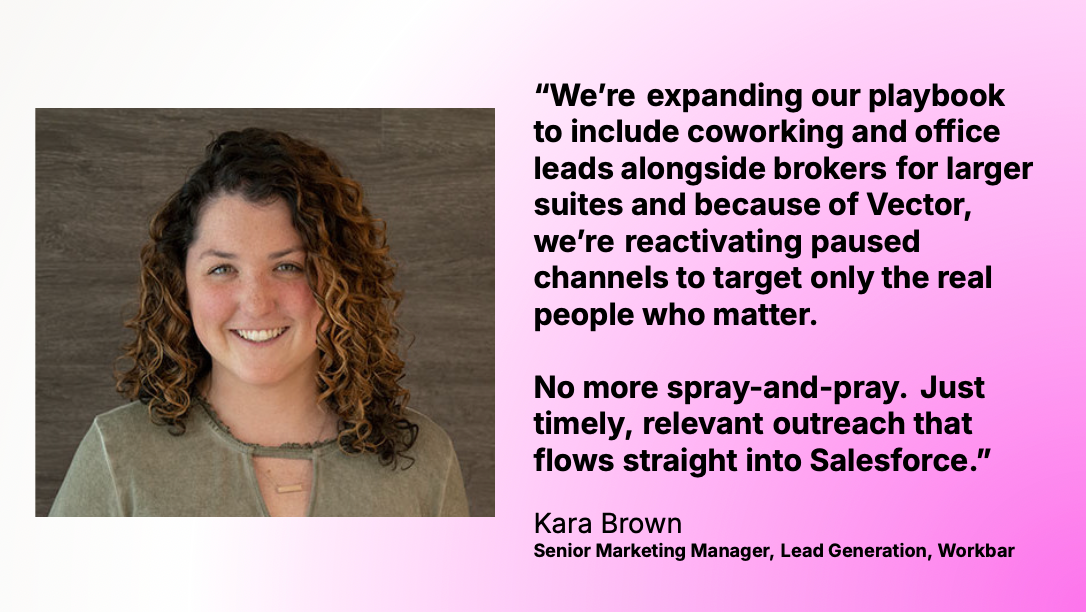
“We’re expanding our playbook to include coworking and office leads alongside brokers for larger suites and because of Vector, we’re reactivating paused channels to target only the real people who matter. No more spray-and-pray. Just timely, relevant outreach that flows straight into Salesforce.”- Kara Brown, Senior Marketing Manager, Lead Generation, Workbar
The Vector way
Most teams still target accounts. But accounts don’t click, people do.
Vector flips that. And so does Workbar.
Workbar uses:
- Website de-anonymization to see who’s on site and what they view
- Signal-based segments that flow to HubSpot for fine-grained filtering, then back to Vector as dynamic lists that stay fresh across ad platforms
- Sales alerts to notify reps especially for high-leverage audiences
Result: precise audiences, fewer wasted impressions, and cleaner hand-offs to Sales.
When to use this play
Use it when:
- You’re reviving or expanding paid channels but want precision over volume
- You need to retarget high-intent visitors and ad clickers with message match
- Prospect activity requires fast Sales follow-up
- Your ICP is broad (industry/size/stage) and lookalikes are too blunt
- You want to uncover who is in the market now
How it works:
Step 1: Build signal-based segments in Vector
Start by creating segments based on the signals that show real buying intent: pricing and comparison views, high-intent content, ad engagement, and roles tied to open opportunities.
Keep segments tight to avoid audience bloat.
Step 2: Enrich in HubSpot, then sync back to Vector
Enhance or filter your segments in your CRM, then push them back to Vector as dynamic lists.
This keeps ad audiences up to date without manual uploads.
Step 3: Sync directly to your ad platforms
Send your signal-based audiences into LinkedIn, Google, Meta, or Reddit: no CSVs, no lookalikes, no broad targeting.
Just real people showing real intent.
Step 4: Align paid with outbound and sales follow-up
Use signals to trigger alerts, give Sales context, and align messaging across channels.
When paid and outbound carry the same narrative, conversion lifts across the board.
Step 5: Track what matters and scale what works
Monitor attribution, downstream conversion, and segment health. Iterate on audience logic and creative based on what drives quality, not just cheap clicks.
Case study snapshot:
measurable lift in paid quality & conversion
Workbar relies heavily on maintaining strong lead→tour and tour→deal conversion rates. Signal-driven targeting made it easier to protect those numbers while scaling paid spend more confidently.
With Vector powering their audiences, Workbar saw clear improvements across quality, attribution, and efficiency:
Higher-quality channel performance: Meta, once turned off entirely due to poor lead quality, is now back in rotation and performing well. Workbar is working towards running Meta and Reddit campaigns using Vector-defined audiences, eliminating the noise that broad targeting and lookalikes introduced.
Faster, more relevant engagement: With dedicated lifecycle stages and real-time alerts, teams can act immediately when high-intent prospects visit the website or engage with ads. Instead of spray-and-pray outreach, this focuses follow-up on the real people who matter, turning passive behavior into warm, well-timed conversations that drive more qualified tours.
Cleaner prioritization through behavior-led scoring: Workbar rebuilt lead scoring around real engagement page views, ad clicks, and returning visits rather than outdated lifecycle buckets. This keeps prioritization tight and supports the tour conversion rates the business depends on.
More efficient spending across every ad platform: A single view of who's clicking on Google, Meta, or Reddit makes retargeting sharper and protects downstream conversion metrics.
What this unlocked
By shifting from broad audiences to contact-level, signal-driven targeting, Workbar strengthened the entire revenue path from first click to booked tour to closed deal.
Paid became a precision lever instead of a gamble.