


Most B2B teams say they want precision.
But their day-to-day still looks like this:
- Broad LinkedIn TOFU campaigns
- Sky-high CPMs
- Account lists without contact clarity
- Sales going into calls blind
That’s what ThoughtFarmer wanted to avoid.
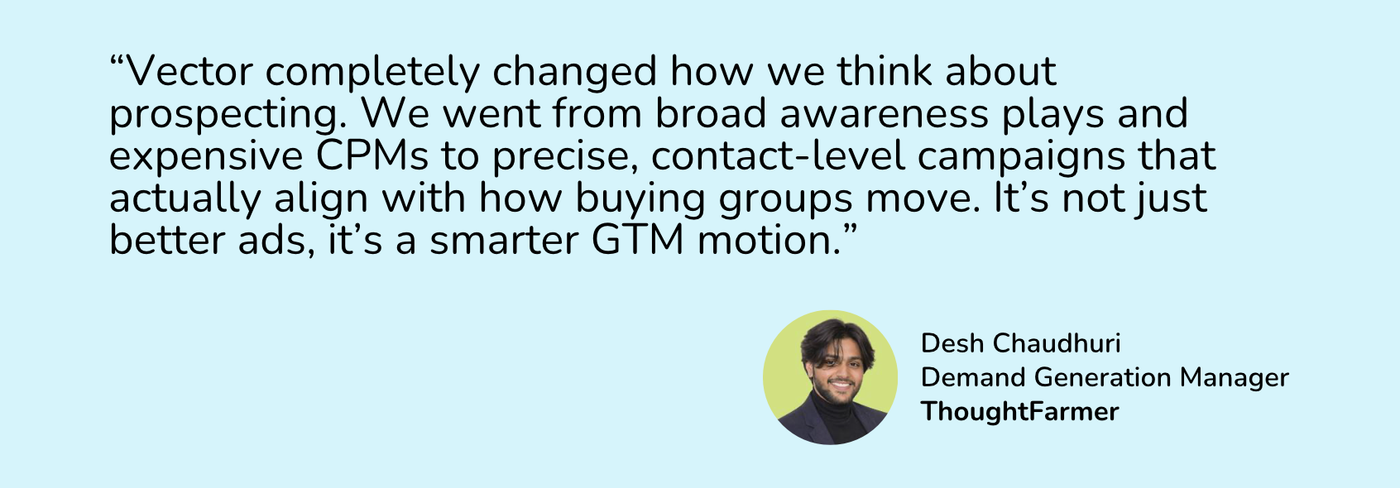
ThoughtFarmer, the B2B easy-to-use intranet, weren’t using any contact-level ABM software. They relied on broad awareness ads on LinkedIn. CPMs were expensive. Targeting was wide. Apollo was used for manual verification, but the workflow was disconnected and lacked precision.
They knew they wanted to be more strategic.
With Vector, their marketers were able to super charge their programming.
Instead of targeting broad, less-defined groups on LinkedIn, they now build hyper-specific persona lists using both on-site and off-site intent. They identify niche audiences where they can add value and target those exact contacts across multiple platforms.
Their motion shifted from broad awareness to precision-based, multi-channel execution where they meet the buyer exactly where they are.
Plays to run
ThoughtFarmer turned Vector signals into repeatable, cross-functional plays that connect marketing, RevOps, and sales.
1. High-intent persona targeting
Signal: On-site + off-site intent from specific personas
Audience: Niche, high-value segments (e.g., Banking personas)
Campaign:
- Sync contact-level audiences into LinkedIn
- Mirror the same audience into Meta via Vector
- Align messaging by lifecycle stage
Result:
A 120% increase in engagement rate.
By narrowing focus to high-intent audiences, clicks became higher quality. They weren’t just driving traffic, they were driving relevant traffic.
2. The “Meta arbitrage” strategy
Signal: Highly engaged, expensive LinkedIn audiences
Audience: Contact-level segments built in Vector
Campaign:
- Target on LinkedIn for credibility
- Expand to Meta for efficient scale
On LinkedIn, their highly engaged “Banking” audience was seeing CPMs near $3,000.
By pushing that same audience to Meta via Vector, they achieved $1.50 CPM.
That’s not incremental efficiency. That’s strategic leverage.
Instead of draining budget on one platform, they now surround the buying committee across channels efficiently.
3. Pre-call intelligence for sales
Signal: Identified traffic from ads (de-anonymized contacts)
Audience: Known visitors engaging with product pages
Campaign:
- Surface contact-level insights to sales
- Align outreach to what the prospect actually engaged with
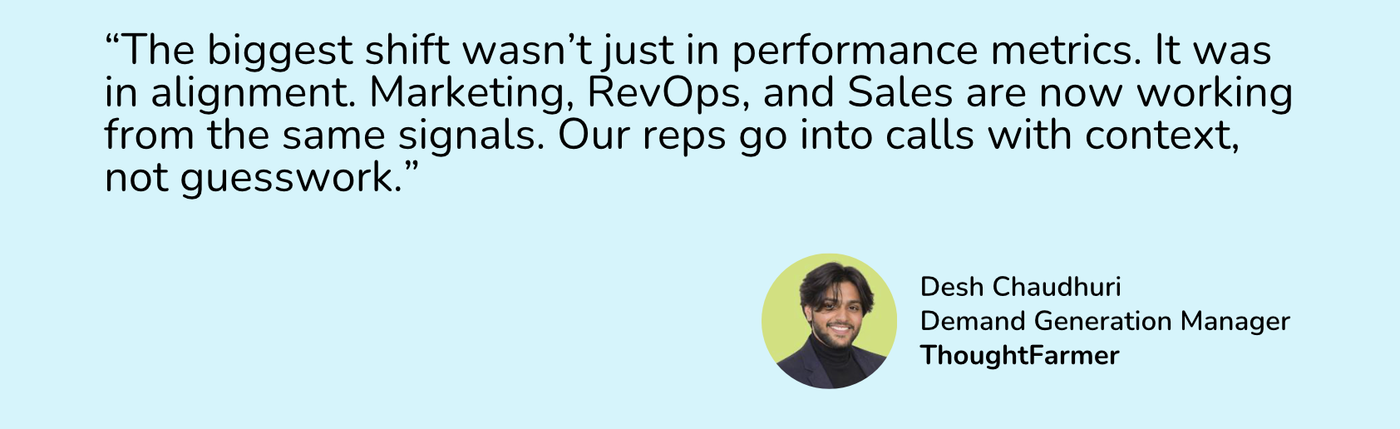
Instead of going in cold, reps now know exactly what prospects viewed.
Conversations start warmer. Context replaces guesswork. Timing improves.
If someone is visiting a specific product page daily, sales doesn’t wait three days. They move now.
4. Buying group prioritization
Contact-level visibility changed how they prioritize accounts entirely.
If three people from different departments at the same company are researching them, that’s no longer invisible.
That’s a buying group forming and that becomes a priority.
5. Journey-based creative
Before Vector, segmentation by funnel stage was aspirational.
Now it’s operational.
They serve:
- “Problem aware” ads to TOFU
- “Solution aware” ads to mid-funnel
- “Decision/Pricing” ads to BOFU
They also run competitor-conquest campaigns triggered by off-site research intent. If someone starts researching a competitor, ThoughtFarmer can immediately trigger differentiated messaging.
Not reactive. Proactive.
The impact
By combining signals, ads, and sales alignment into one motion, ThoughtFarmer:
- Increased engagement rates by ~120%
- Dramatically improved traffic quality
- Reduced effective CPMs by shifting high-value audiences from $3,000 LinkedIn CPMs to $32 on Meta
- Turned prospecting into a defined GTM vertical
- Shifted reporting from “clicks” to lifecycle stage movement
- Unified Marketing, RevOps, and Sales into one workflow
Their new motion:
Sales identifies target accounts →
Marketing builds contact-level audiences in Vector →
Lifecycle stage dictates messaging →
Sales engages with context and timing.
No more siloed departments.
One GTM unit.
How you can run these plays
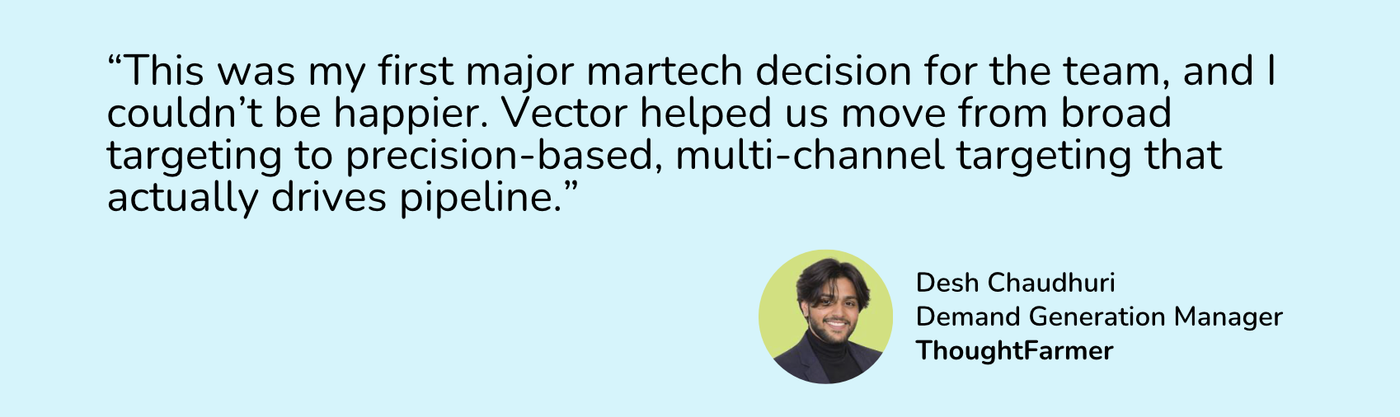
ThoughtFarmer’s results show what happens when you move from account-level guesswork to contact-level precision.
To replicate this:
- Define your signals
Start with 2–3: high-frequency product page visits, competitor research, multi-threaded account activity. - Build persona-level segments
Don’t just target accounts. Identify the actual people showing intent. - Activate cross-platform
Use LinkedIn for credibility and Meta for cost efficiency. Surround the buying group. - Align lifecycle reporting
Stop reporting on clicks. Start reporting on movement between funnel stages.
Feed sales context in real timeOutreach should match what prospects are doing now not what they did last week.