


Most B2B teams say they have an ICP.
Few can tell you what layer of their market it actually represents.
Is it TAM?
Is it a prioritized sales list?
Is it just “accounts we uploaded”?
When markets tighten and pipeline anxiety rises, those distinctions matter. Let’s break it down.
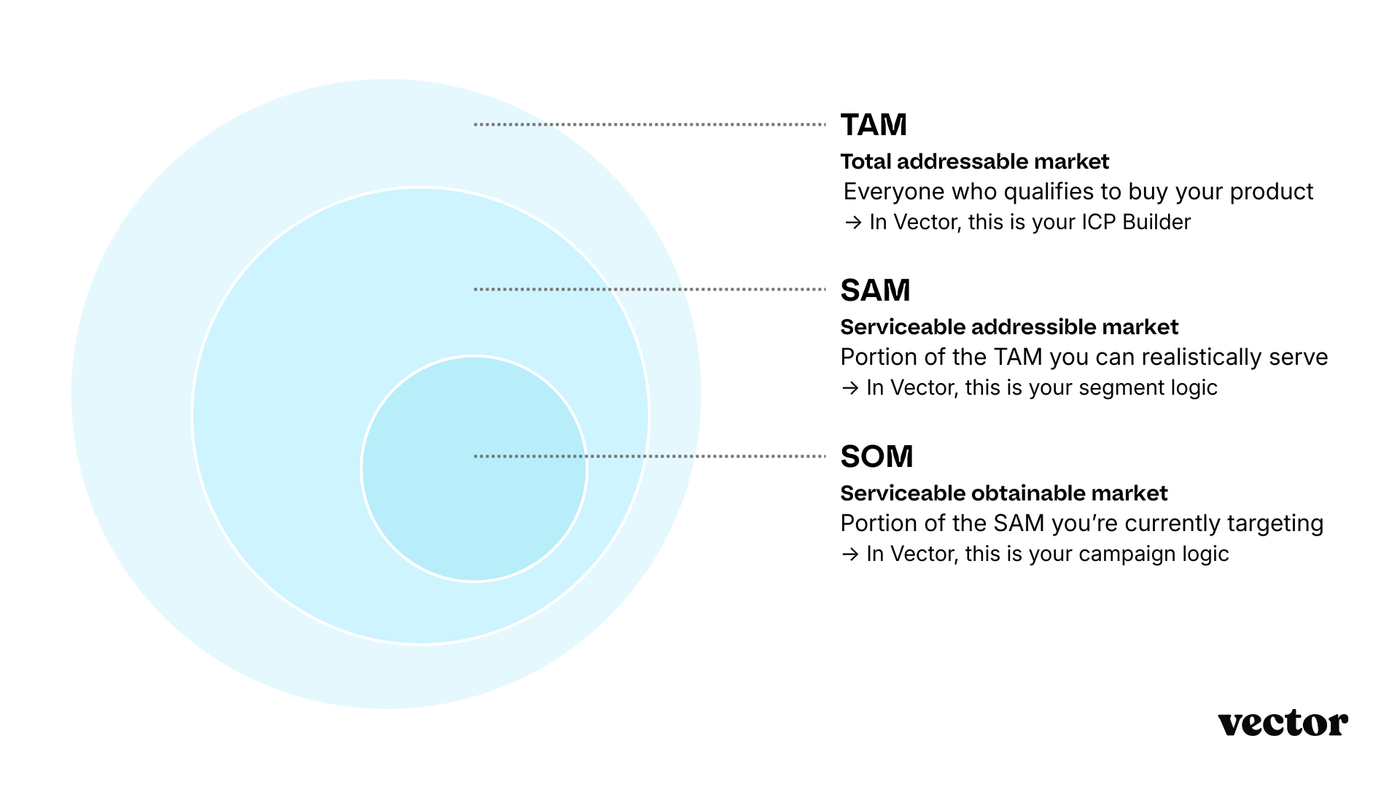
First: the definitions
TAM: Total Addressable Market
Everyone who could buy your product.
Not who you know. Not who’s in Salesforce. Not who sales likes.
Everyone who qualifies based on:
- Industry
- Company size
- Geography
- Buyer type
- Business model
TAM is your market ceiling.
It should be broad.
SAM: Serviceable Addressable Market
The portion of TAM you can realistically serve.
This might include constraints like:
- Geographic limitations
- Product maturity
- Integration requirements
- Industry focus
SAM is narrower than TAM.
Still broad, but operationally realistic.
SOM: Serviceable Obtainable Market
The slice you’re actually targeting right now. Campaign-level logic.
Think:
- High intent
- Hiring signal
- Competitive research
- Named accounts
- Excluding customers
SOM is where marketing and sales execute.
Where most ICPs go wrong
Many companies say:
“Our ICP is our target account list.”
That’s not TAM. That’s SOM. Or maybe SAM.
But it’s rarely the full market definition.
When ICP is defined by a spreadsheet:
- It reflects who you already know.
- It reflects who someone uploaded.
- It reflects sales priorities.
It doesn’t reflect market reality.
Where Vector’s ICP Builder fits
Vector’s ICP Builder is designed to define TAM inside the system.
Not campaign slices. Not named account lists.
It allows you to define your market using logic across Vector’s dataset:
- Industry
- Company size
- Department
- Seniority
- Job title
- Intent
- Optional account lists
And critically: You can now estimate audience size while building it.
This is important because TAM should be measured.
If your ICP returns:
- 50,000 people — that’s narrow.
- 250,000 — still small.
- Low millions — likely healthy for many B2B categories.
Major key: Without visibility into size, teams under-define their market.
How it works in practice
Think of it in layers.
Layer 1: Define TAM (ICP Builder)
Example:
- US FinTech
- 200–5,000 employees
- Director+
That’s broad. That’s TAM logic: you’re defining who could buy.
Layer 2: Define SAM (Segment Logic)
You refine further:
- ICP
- Industry sub-vertical
- Product-fit signals
Now you’re closer to serviceable reality.
Layer 3: Define SOM (Campaign Logic)
You narrow for execution:
- ICP
- Hiring growth roles
- High intent
- Exclude customers
- Competitive research
Now you’re in activation territory.
This is what gets pushed to ad platforms.
Why this matters for paid activation
Vector’s ICP can now power ad audiences directly.
That means:
- TAM defines the universe
- Segments define the slice
- Ad platforms handle delivery
Important nuance:
ICP definitions themselves are not capped. Direct audience pushes are currently capped at 500k (increasing).
Which reinforces the model: define TAM broadly. Slice intentionally.
A real example
Our Demand Gen team tested this internally.
They:
- Defined a TAM-level ICP for US FinTech.
- Built a 10,000-account lookalike set based on hiring + digital ad signals.
- Used that list as a filter inside ICP Builder.
- Let Vector identify the TAM population inside that logic.
- Created a LinkedIn-ready audience.
- Excluded customers and trials.
- Launched.
The shift wasn’t in sourcing.
It was in what happened after.
Vector replaced waterfall enrichment and manual validation with logic-based materialization.
The mental shift
Stop thinking: “My ICP is my list.”
Start thinking: “My ICP is my TAM logic.”
Lists are inputs. Logic defines the market. Activation slices define execution.
Why this matters now
Markets are tighter.
Budgets are scrutinized.
Coverage gaps matter.
If your ICP is too narrow, you’ll never know why pipeline feels thin.
If it’s too broad, you’ll waste spend.
Vector’s ICP Builder gives you visibility and control at the TAM layer.
Not just at the campaign layer.
That’s the difference.