


The pressure to plug AI into your workflows is real. We know marketers are feeling it especially hard.
Launch 10 campaigns instead of two!
Automate your entire paid acquisition!
Never touch Ads Manager again!
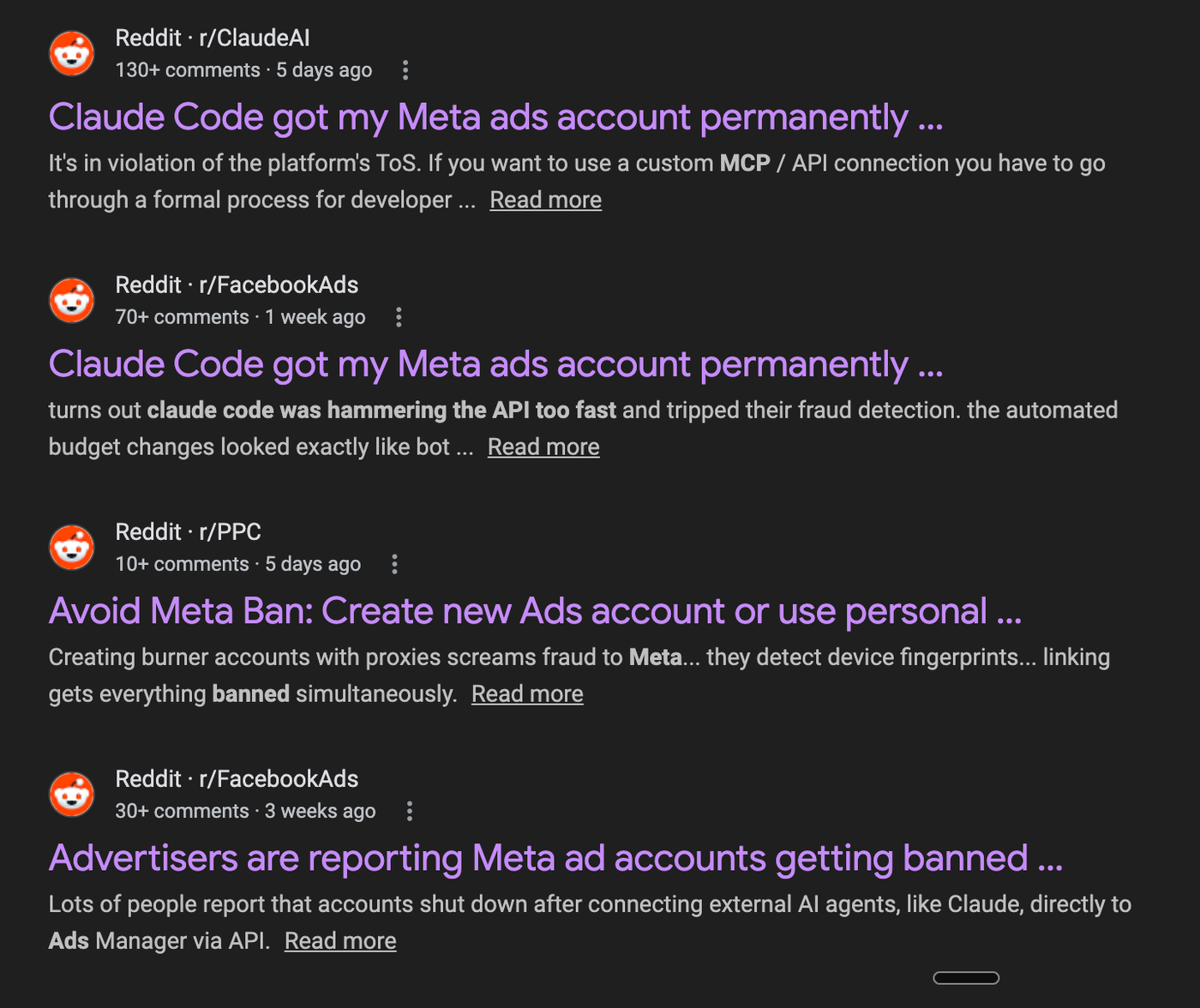
But scroll past the hype… keep scrolling… right past the people handing AI the keys to their ad accounts… and you’ll find a different conversation happening:
“Letting Claude (or any AI agent) control your browser to pause, edit, or manage ads inside Meta’s ad platform is a fast track to getting both your personal account and ad account banned.”
“Claude doing the work is the easy part. Keeping your Meta account alive while it does is the hard part.”
“So many people have had their accounts permanently banned doing this even with millions in ad spend. Please don’t do this!”
These are real comments from marketers who are all too familiar with the sting of losing an ad account overnight. The campaign data, custom audiences, pixel history… all of it, gone.
That’s the gamble you take when you let AI manage your ad accounts without knowing how it’s connecting to the platform.
MCPs are supposed to be the answer here. They’re the layer between AI and your data that makes the connection structured and safe.
But a lot of MCPs hitting the market right now are cutting corners.
What’s actually happening under the hood
Here’s what those shortcuts that can get you in trouble look like:
- Thin API wrappers without partner approval. Some MCP tools are just wrapping the ad platform’s API without being an approved partner. They’re accessing your data, but they don’t have a formal relationship with the platform. That means there’s no accountability, no compliance review, and no guarantee they’re following the platform’s terms of service.
- Browser automation. Some tools use AI to literally take over your browser and click around your ad platform. This might sound clever, but ad platforms are not designed to be operated this way. They have detection built in. If the mouse moves in a straight line to a button and then jumps somewhere else within 100 milliseconds, they know. And they’ll flag your account.
- Hammering the API. Every ad platform has rate limits. They’re designed to prevent abuse. Some MCP tools make a live API call every single time you ask a question, which means your account is getting hit with requests constantly.
The frustrating part is that the front-end experience looks the same regardless of how the tool is built underneath. You type a prompt, you get an answer. You’d never know the difference between a tool that’s an approved API partner and one that’s scraping your data through a browser automation hack.
Not until something goes wrong.
OK, well… what’s the worst that could happen?
The worst-case scenario is that you lose your ad account, permanently.
We’re already seeing anecdotal reports across Reddit and marketing communities of accounts getting permanently banned after connecting automation tools that violated platform terms. The appeals process, where one even exists, doesn’t have a great track record. And platforms like LinkedIn have historically banned automation companies on the organic side, from outreach tools to scraping tools. Ad accounts connected to unauthorized tools face the same exposure.
But even if you don’t get banned outright, the subtler risks are real too:
- Rate limiting. Too many API calls and your data access gets throttled, which means slower or incomplete results.
- Unreliable data. If the tool is pulling from the API inconsistently, the numbers you’re getting back might be stale or just wrong.
- No caching. Every question you ask fires another live request against your account’s API quota, which adds up fast.
Then there’s the data security side. You’re connecting a tool to your ad account, which raises questions like:
- Where is that data going?
- What’s their storage policy?
- Are they SOC 2 compliant?
- Who actually built this thing?
Half of the MCP tools out there are open-source projects you find on GitHub and install with no real vetting process.
If you’re a marketer at a company spending real money on ads, that’s not a risk you want to take casually. And it’s definitely not a conversation you want to have with your boss after the fact.
And if you don’t know, now you know
Most marketers have no reason to think about any of this. The MCP ecosystem is still young. Auth, versioning, governance: all of it is being figured out in real time. That’s just the reality of where things are, not a criticism of the technology.
The broader AI landscape has plenty of cautionary tales, too. Apps in AI tool stores that were stealing user data. Prompt injection attacks where someone emails a CEO knowing an AI tool will read the message and act on it. New surface areas, and the security norms haven’t caught up yet.
So it makes sense that you’d probably never think to ask whether the MCP you just installed is an approved API partner. You’d check if it supports your ad platform. You’d look at the prompts it can handle. You’d maybe read a review or two. But the question of “is this tool accessing my data in a way that could get my account banned” just doesn’t come up until there’s a problem.
If you’re evaluating an MCP tool, here’s what’s worth looking at:
- Their privacy policy and what data they retain
- Whether they have read-only or read-write access to your accounts
- What exactly they can see and do inside your ad platform
- Whether you can control permission levels across your team
We’re not like a regular MCP, we’re a cool MCP
We’re not going to pretend we don’t have a point of view here. We built Vector MCP with these problems in mind.
Three things matter:
- We’re approved API partners with the ad platforms we connect to. We have a formal relationship with the platform, we’ve gone through their compliance review, and we’re accessing data the way they intended.
- We use the proper API. No browser automation. No scraping. No workarounds. The data comes through the channels the platform built for this purpose.
- We cache your data. Instead of making a live API call every time you ask a question, we store your performance data and refresh it daily. That means you get fast answers without burning through your API quota or risking rate limits. The tradeoff is that if you launched a campaign this morning, today’s numbers won’t be there until end of day. But we don’t think much is lost here—the whole point of auditing your performance is that you usually need more than one day’s worth of data to make a meaningful decision anyway.
One more thing worth calling out: Vector MCP is read-only. It can’t edit your campaigns, turn things off, or reallocate your budget. You still need to log into your ad platform to execute.
That’s intentional. A lot of the automation that other MCP tools are offering—modifying bids, toggling campaigns, shifting your spend—bumps up against platform terms of service. Read-only keeps us on the right side of that line.
We also think marketers have taste and judgment that AI shouldn’t replace. The hard part of marketing isn’t clicking the button to turn off a campaign, it’s knowing whether you should. Our MCP does the heavy lifting of pulling data and analyzing it so you can spend your time on those strategy calls, not spreadsheets.
The bottom line
MCPs are going to change how marketers work. We believe that, and we’re building toward it.
But right now, the market is moving fast, and most people aren’t stopping to ask whether their MCP is accessing their accounts in a way that’s safe, compliant, and designed to last. The tools you connect to your ad accounts matter as much as the campaigns you run in them. We’d rather build this right than skip the steps that keep your accounts in tip-top shape.
If you’re on the same page and want to take Vector MCP for a spin, sign up for access here →