


Marketers don’t have a data problem.
They have an access problem.
The answers already exist: buried in ad platforms, analytics tools, CRM systems, but getting to them is slow, manual, and fragmented.
That’s where MCP comes in.
What is an MCP?
An MCP (Model Context Protocol) is a new way to interact with your data.
Instead of clicking through dashboards or building reports, you can query your data directly using natural language.
Ask a question → get an answer.
No filters.
No exports.
No stitching data across tools.
It turns your data into something you can actually use.
Why this matters for marketers
Most marketing decisions still rely on lagging, incomplete, or disconnected data.
You’re:
- Switching between platforms to piece together performance
- Waiting on reports (or building them yourself)
- Making calls without full visibility
MCP changes that.
It gives you direct access to the signals that matter when you need them.
Not summaries. Not snapshots.
Why Vector is building MCP for marketing
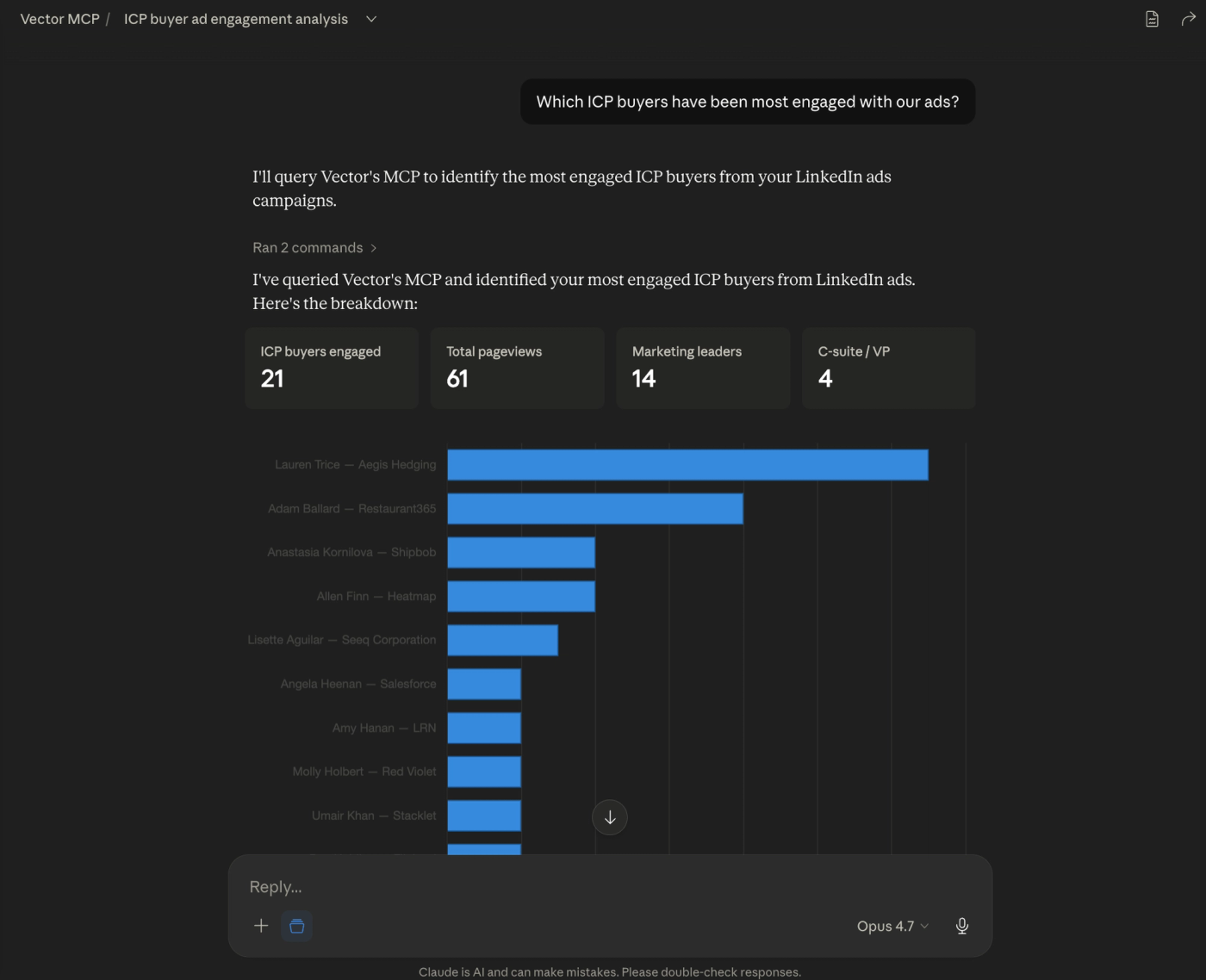
Most MCPs today are being built for developers. We’re building one for marketers.
That means:
Grounded in real marketing data
Vector MCP connects directly to your LinkedIn ads and de-anonymized site visitors—so you’re not guessing what’s working or who’s engaging.
Designed for real questions
Not technical queries. Practical ones:
- What’s actually driving pipeline?
- Which creatives are fatiguing?
- Which companies are engaging but not converting?
Built on signals, not assumptions
No anonymous traffic. No account-level guesswork.
Just real behavior, from real people.
Built differently: trust and safety first
There’s a right way to build MCPs and a wrong way.
Some tools take shortcuts:
- Scraping data
- Bypassing platform terms
- Risking your ad accounts
Vector MCP doesn’t.
It’s built within platform boundaries, so your data, and your accounts, stay protected.
Because speed doesn’t matter if you can’t trust the system.
What this unlocks
This isn’t just a faster reporting layer. It’s a shift in how marketing works.
From:
- Chasing down data
- Piecing together insights
- Reacting after the fact
To:
- Asking better questions
- Getting immediate answers
- Acting in the moment
How to get your data ready for an MCP
MCP doesn’t fix messy data.
It exposes it.
The better your inputs, the better your answers.
Here’s how to get ahead:
Clean up your campaign structure
Standardize naming. Consolidate duplicates. Align to clear goals.
Get serious about UTMs
Consistent parameters = connected data. Audit for gaps.
Define your ICP clearly
Firmographics, segments, exclusions, be precise.
Pressure-test your conversion points
Know what actually counts. Make sure it’s tracked correctly.
Align with sales on “pipeline”
If you’re asking what drives pipeline, make sure that definition is real.
Audit your data gaps
Find them now, before MCP does.
The bottom line
MCP doesn’t replace your data strategy. It makes it usable.
The teams that win won’t be the ones with the most tools, they’ll be the ones with the cleanest, most connected signals.
What’s next
We’re rolling out Vector MCP soon, starting with LinkedIn ads and site activity with more integrations coming.
👉 Join the waitlist.