

The gap account-level tools cannot close
Fingerprint builds device intelligence infrastructure, with buyers sitting in product, engineering, and fraud teams across fintech, e-commerce, and other enterprise verticals. The average prospect logs 17-plus touchpoints before converting, which means precision matters more than volume at every stage of the funnel.
To move upmarket and land larger deals, they needed to get precise about which signals actually preceded enterprise conversions and build their advertising around those. Alexander Goodwin, Fingerprint’s Director of Demand Generation, had built an ABM motion across three tiers to do exactly that:
- 1:1 campaigns with personalized ads and landing pages for their highest-priority enterprise accounts
- 1:few campaigns segmented by use case and industry for broader but still targeted reach
- Brand plays across the full target account list
It was running into real limitations.
The mechanics at the 1:1 level were standard: pull a list from Apollo, import it into LinkedIn as a CSV, run ads against it. Match rates sat around 40-50%. Half the list, unreached, every time.
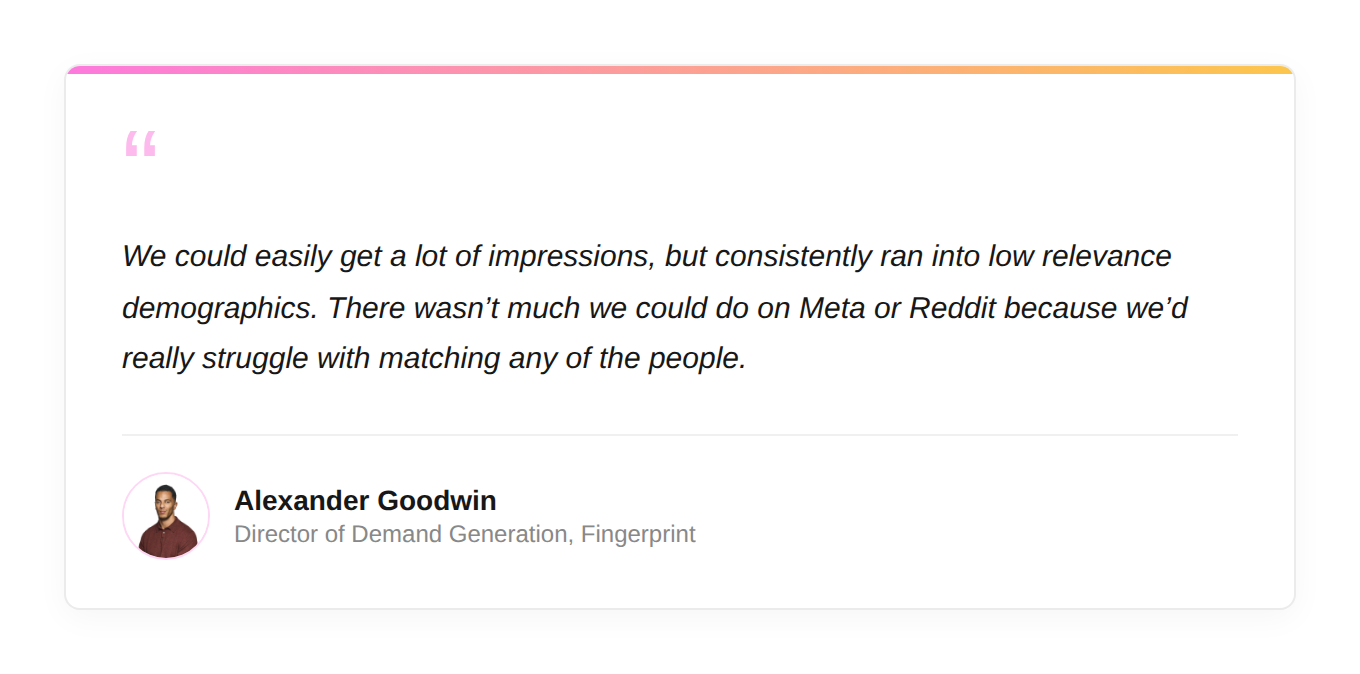
Platforms like Meta and Reddit sat outside the ABM motion entirely. Their tools had no way to match a B2B contact list to actual people on those platforms, so targeted work stayed on LinkedIn. For broader campaigns, Fingerprint used Metadata, running Salesforce account lists against LinkedIn’s title-based matching. The volume was there, but the quality was not.
The website presented a deeper problem. Fingerprint had started an internal project to map how prospects moved from first exposure to conversion, called the Customer Journey. They had account-level identification. They had Metadata. But none of it, as Alexander described it, gave them meaningful signals that sales and marketing team could act on.
They could see which company was on the site, but they could not see who. “Sure, you have Google Analytics numbers that help you see a count of individuals that have reached the website or an aggregate of views per account,” Alexander said, “but you don’t know who those are.”
He started looking for a solution to fill the identification gap. Most of the tools he looked at were built primarily for sales outreach, the idea being to surface a visitor and route them to a rep. Vector appealed to him because it was oriented around the full marketing motion, using contact-level data to build better audiences, validate campaigns, and understand who was actually engaging rather than just who to call next.
Building an audience worth trusting
First order of business: fix the audience itself.
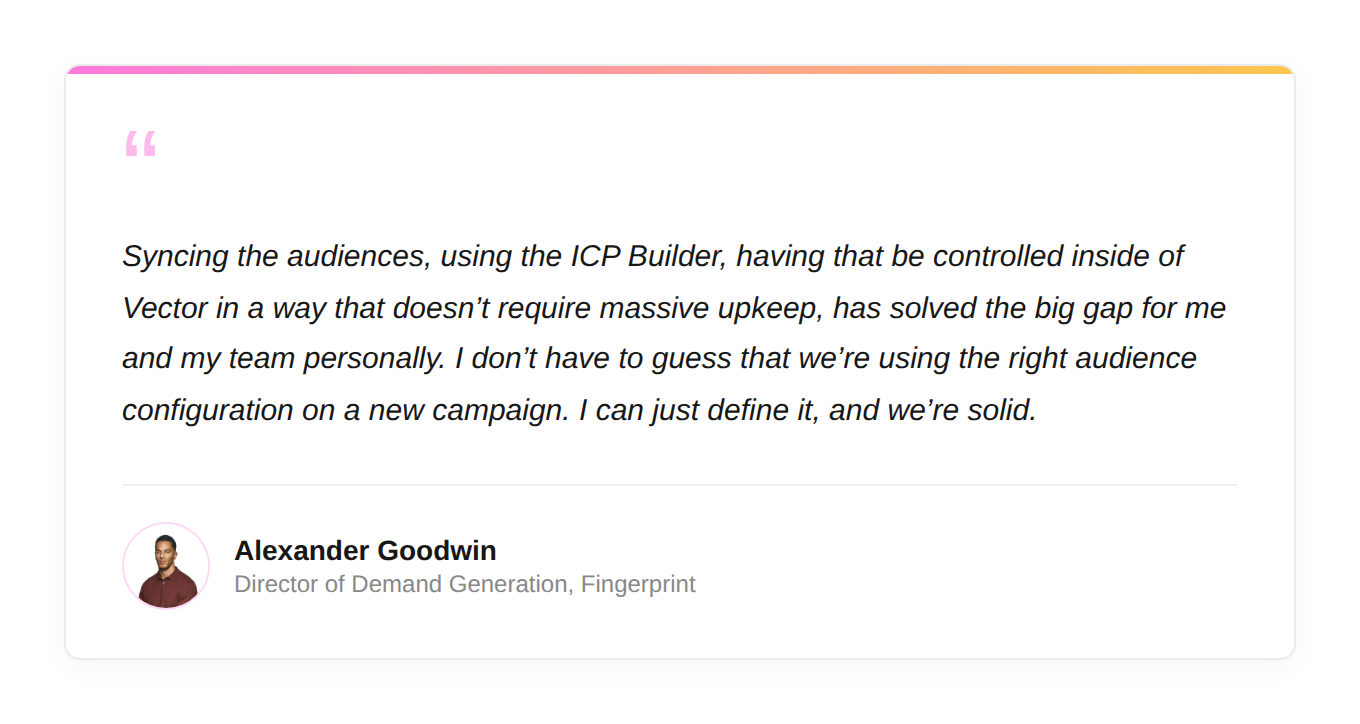
For their brand-level campaigns, Fingerprint used ICP Builder to create a single audience in Vector from their Salesforce account lists. The configuration has stayed essentially the same since setup:
- Accounts segmented across commercial, enterprise, and strategic tiers, plus a secondary list of high-priority unowned accounts not yet assigned to an AE
- Persona filters across product, engineering, fraud, risk, authentication, and identity roles
- Seniority filters to ensure only the right levels are included
- Dynamically synced to LinkedIn, Meta, Reddit, and Google Ads
- Self-updating when new accounts enter Salesforce, no manual work required
For their 1:1 campaigns, they continued pulling contact lists from Apollo and importing them into Vector via CSV, now matching at around 80% on LinkedIn instead of 40-50%.
Getting the audience right on both motions opened up something that had not been possible before. The same contact-level list now worked on Meta, a platform Fingerprint had written off for ABM entirely.
Scroll Stoppers: the campaign that opened up Meta
Their first real test on Meta was a brand campaign they called Scroll Stoppers. They treated it as an experiment and even split the audience into a developer segment and a decision-maker segment to see whether seniority-based creative differentiation moved the needle. It did not produce a clear winner, but the ability to run that test in days, without rebuilding the audience from scratch, was itself a signal about how the workflow had changed.
The numbers came back well ahead of expectations.
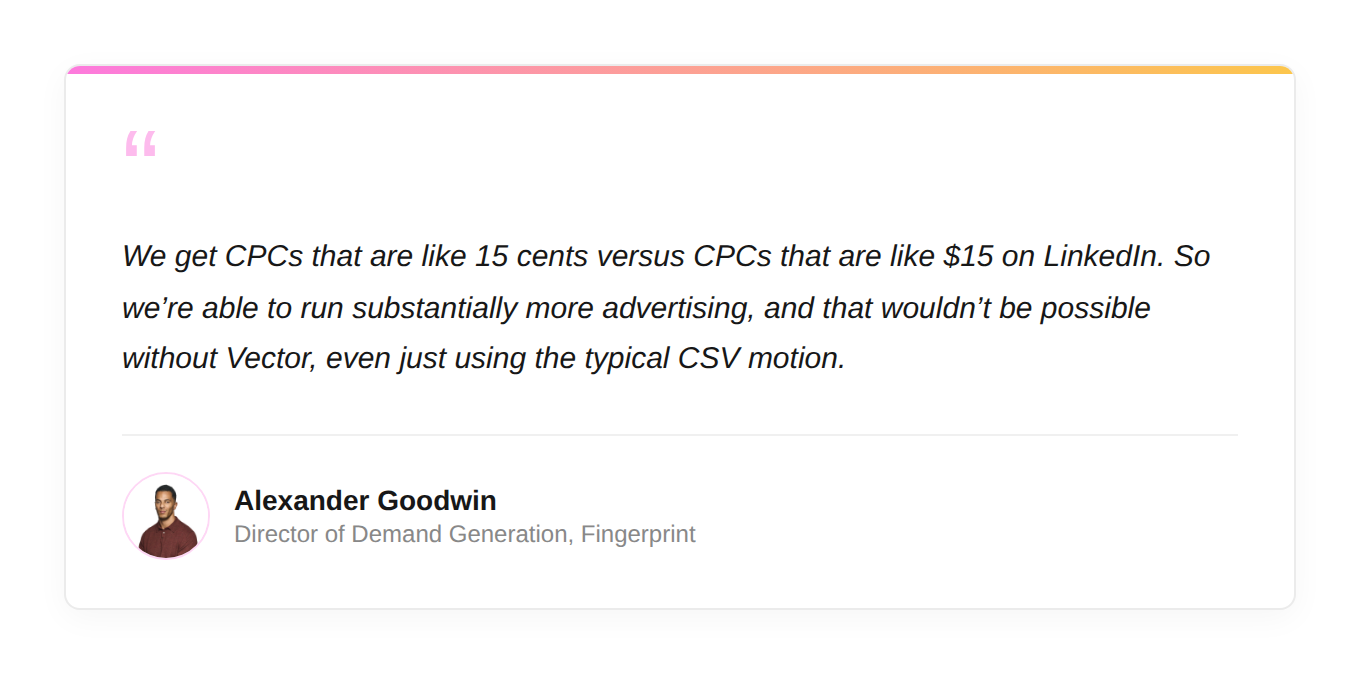
At $0.11 a click against $15 on LinkedIn for identical personas, Fingerprint was running a volume of advertising their budget simply couldn’t have supported on LinkedIn alone. A 4.2% CTR on a brand campaign validated the audience, and the cost structure meant they could keep scaling without the budget constraints that previously made Meta a secondary consideration.
Through Vector, they could see the specific companies and job titles hitting the site from the campaign via UTM, confirmation that the right people were clicking and engaging. That cut the scaling window from 30 days to 14. Previously, they waited a month before increasing spend because there was no earlier signal that the audience was working. Here they knew in two weeks, scaled to 5x budget, and added five new creative variants.
What you can do when you trust the audience
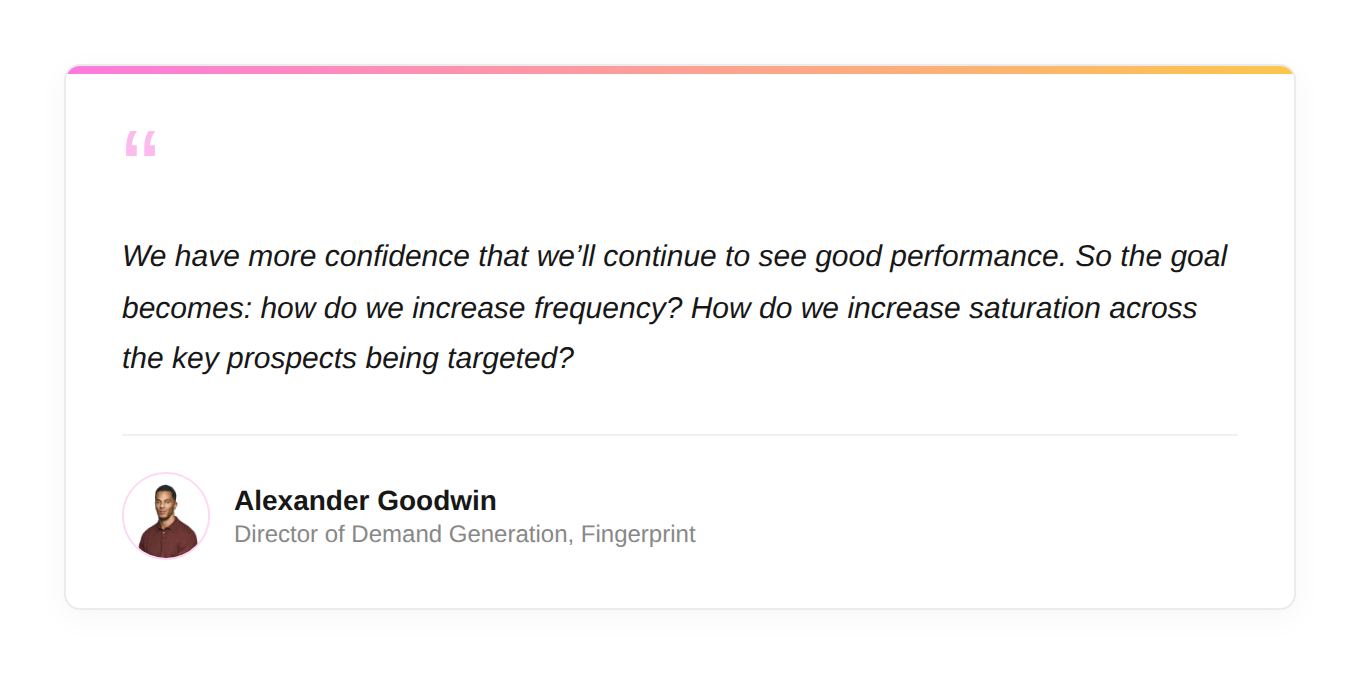
Scroll Stoppers answered a question Fingerprint had not been able to answer before: are the right people seeing this? Once they had a reliable answer, everything else moved faster.
For campaigns that had been bleeding spend, the issue was manual bid management. It was time-consuming, inconsistent, and left room for waste that was hard to diagnose. Fingerprint deployed Bid Agent across eight campaigns. It handles optimization automatically, and on those campaigns CPCs have dropped roughly 3x on average.
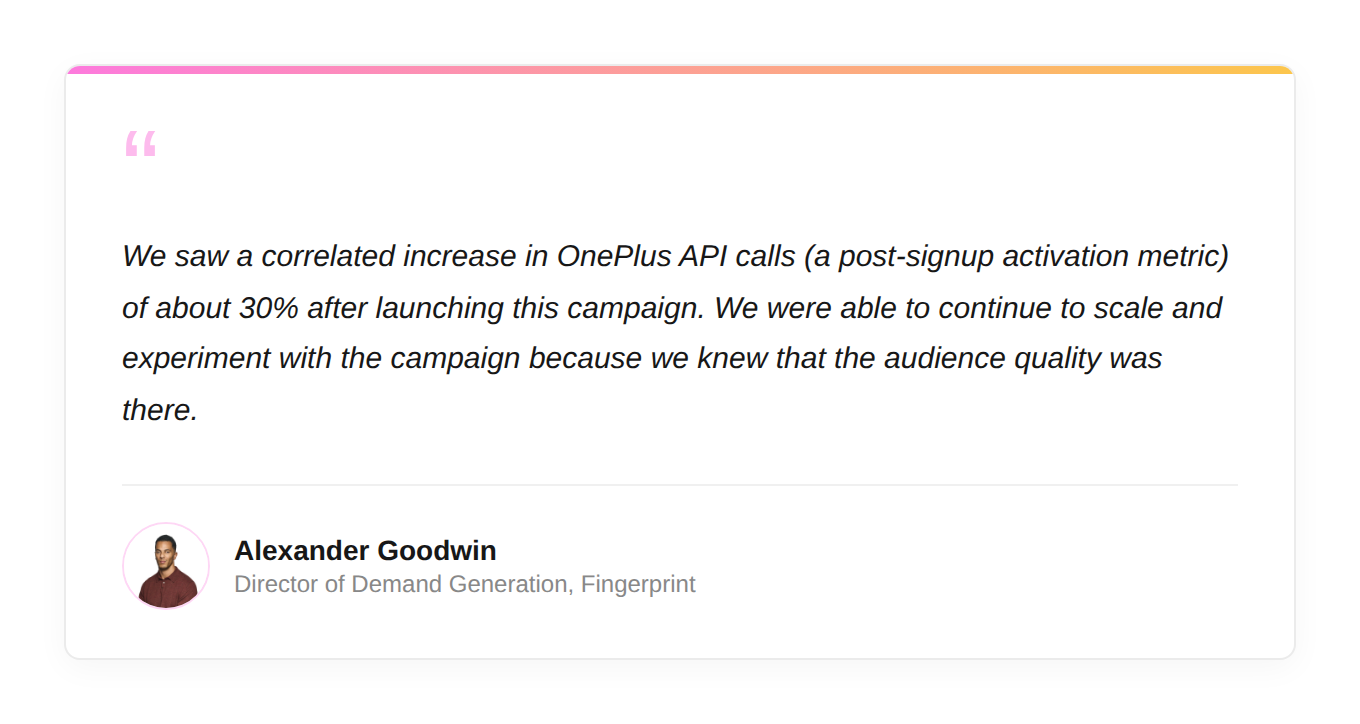
Better audience quality showed up across the whole motion, not just on Meta. On tier-one ABM campaigns, CTRs moved from a 0.5% benchmark to as high as 0.7% and average CPCs fell 15-20%. By the end of the quarter, their account engagement goal had been exceeded by 50%.
The time-to-scale improvement compounds across all of it. Hitting performance benchmarks faster means more budget goes toward scaling what works and less toward the waiting period.
From account signals to contact actions
Getting the audience right had an obvious impact on campaign performance, but it also changed how sales operated.
Fingerprint built an internal customer journey dashboard, a data warehouse that pulls together campaign membership, website activity, sales engagement, and conversion milestones for every account. Vector visitor ID feeds into it in real time via webhook.
So does off-site intent data, signals from contacts who are actively researching relevant topics before they ever visit the Fingerprint site. Fingerprint monitors intent topics that map directly to their buyers, things like device fingerprinting, account takeover, payment fraud, and e-commerce fraud. When those intent segments show activity, that feeds into the dashboard too, giving reps visibility into where an account is in their research process before anyone has filled out a form.
Three things happen automatically from there:
- A researching contact triggers a heat rating update on the account and surfaces in the dashboard
- A director-level site visit fires a Slack alert to the rep with the specific page visited
- BDRs pull prioritized outreach lists from intent segments, reaching people already in-market
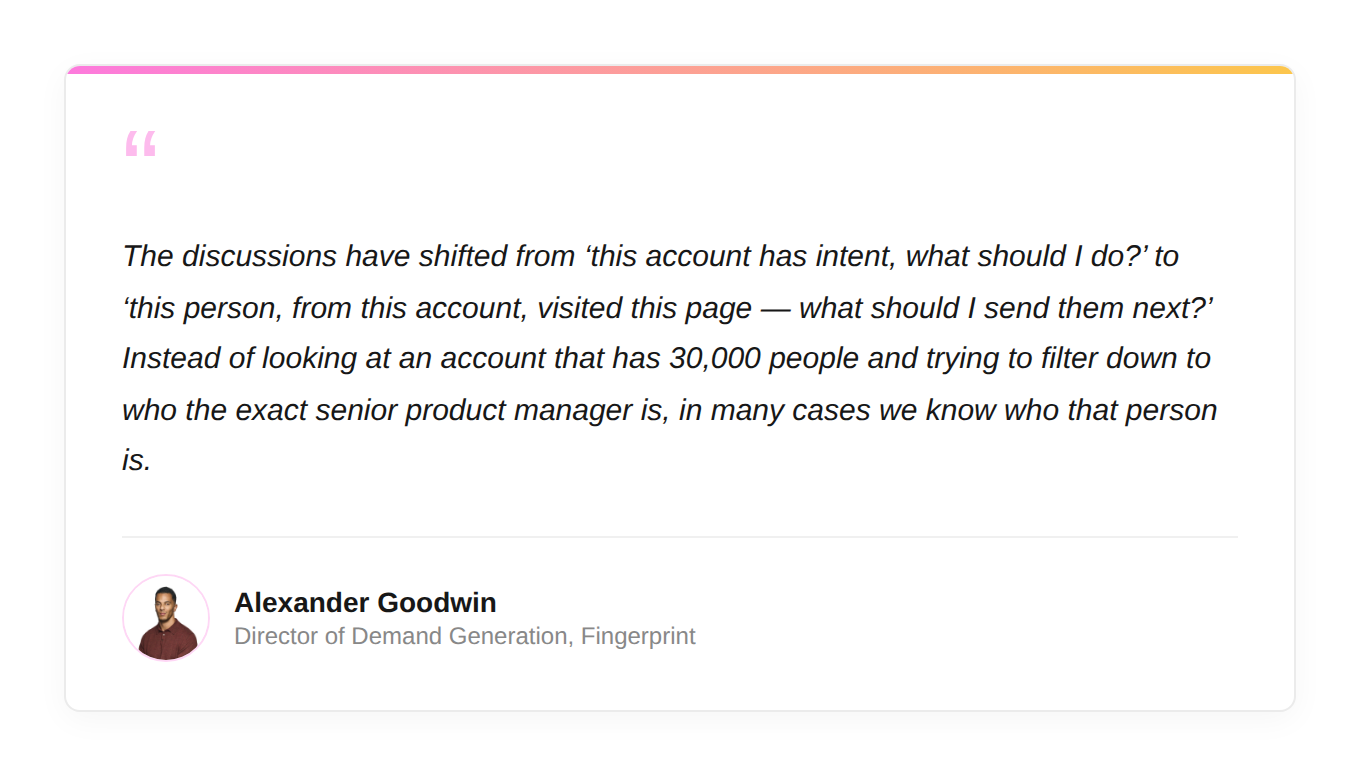
Reps now reach individual contacts with specific context rather than warming up entire accounts from scratch. The same intent data also drives contextual advertising across channels like Reddit. If the intent segment is device fingerprinting, for example, they run long-form educational content on that topic, getting in front of the right people during the research phase.
What’s next
Alexander’s team is building in several directions. Among the most immediate: getting more out of events, and following up more effectively with people who engaged but dropped off before taking the next step.
On events, they have already started testing. Before a recent in-person activation, Fingerprint ran targeted ads to every account in the area ahead of the event. The logic is that walking into a meeting with someone who has already seen your ads for a week is a different conversation than walking in cold. Post-event retargeting to registrants is the next piece they are building out.
For digital motions, they have a few priorities:
- Tighter retargeting sequences for PLG users who started signup but did not finish
- Post-webinar advertising to registrants who showed interest but did not convert
- Additional segmentation across ABM campaigns
Learn more
Much of what Fingerprint built runs on the same underlying problem most demand gen teams are dealing with. Most teams don’t actually know who is seeing their campaigns or whether the right people are engaging. Vector is built to solve this gap, helping teams move from account-level guesswork to contact-level precision across every channel they run. If you want to see what that looks like for your motion, book a demo.