


A tier decides how much of your team's time and budget an account gets, so a tier you set once a year spends this quarter's money on last year's guess. One-to-one ABM, one-to-few, and one-to-many are levels of effort. Fit tells you where an account should start. What the people inside the account do next should decide whether it stays there.
Here's how to set the tiers, what each one gets, and the rules for moving accounts between them.
TL;DR
- 1:1, 1:few, and 1:many describe how much tailored effort an account receives. They're a way to ration capacity.
- Set the starting tier on fit and current relevance, and test the tiering against closed-won and closed-lost deals before you trust it.
- Promote accounts when named contacts engage. Demote them when they go quiet. Write both rules down.
- A Tier 2 account with an active buying committee outranks a Tier 1 account that's silent.
- Size Tier 1 to what your reps can work each week, and let the rest of the list run on automated plays.
What 1:1, 1:few, and 1:many mean
The three labels describe treatment.
- 1:1 (one-to-one ABM). A plan built for a single account: named contacts mapped, messaging written for that company, a rep who owns it. Expensive per account, reserved for the deals that justify it.
- 1:few. Small clusters of similar accounts that share an industry, a tech stack, or a problem. Messaging is tailored to the cluster and the persona.
- 1:many. The rest of the target list, reached with programs that scale: ads to ICP-fit contacts, automated sequences, content.
Tiers (1, 2, 3) are how accounts get assigned to those treatments. In most programs Tier 1 gets one-to-one effort, Tier 2 gets one-to-few, and Tier 3 gets one-to-many. The labels matter less than the fact that each tier has a different cost, which is why putting an account in the wrong one is expensive in both directions. You overspend on an account that isn't moving, and the account that's researching you this week gets a generic ad.
Set the starting tier on fit, then test it
Fit is the standing profile every account is measured against: industry, size, tech stack, and how the company goes to market, grounded in the customers you've won and kept. Relevance is what's changing at the account right now that makes it reachable, such as a funding round, a new marketing leader, or hiring for the role you sell to. Tier 1 should hold the accounts with the tightest fit and the most going on.
Then check the tiers against reality. Run the tiering model over your closed-won and closed-lost deals and see whether it would have sorted them correctly. When one B2B team back-tested its account tiers this way, the gap between tiers was large: top-tier accounts converted from lead to opportunity at 30% on LinkedIn ads, the next tier at 8%, and the bottom two tiers at a rate the team called a rounding error.
That spread is the argument for tiering carefully. If your tiers don't separate accounts that convert from accounts that don't, the tiering is decoration and every account is effectively getting the same program.
What each tier should get
Match the play to the cost of the tier.
- Tier 1. A sales alert when something happens, manual outreach from the account owner, ads to the named buying committee, and a plan the rep has agreed to.
- Tier 2. Retargeting ads to identified contacts and automated outreach, with persona-level messaging shared across the cluster.
- Tier 3. Automated programs only. No rep time until the account earns it.
Size Tier 1 from capacity. If each rep can work about fifteen contacts a week properly, that number sets how many Tier 1 accounts the team can hold. A Tier 1 list that's three times what sales can cover is a Tier 2 list with a better name.
Rep belief counts here too. The accounts that perform best are the ones where the data says the account is a good target and the rep wants to work it, so involve sales when you assign Tier 1. It's one of the first steps in our ABM playbook.
When to move an account up
Engagement from identified people is what should promote an account. A static tier ignores the one input that matters most for timing.
Write the promotion rules down so they're applied the same way every week. A workable set:
- Named contacts, high-intent pages. Identified people from the account visit pricing, integrations, or comparison pages.
- More than one person. Two or three different contacts engage within the same couple of weeks. One visitor is curiosity. Several is a committee forming.
- Signals that stack. Something changed at the company, the buying committee is engaging, and research activity is up, all inside the same window. No single signal is a play. The combination is.
Two tie-breakers help when capacity is tight. A Tier 2 account with a warm buying committee outranks a cold Tier 1 account, so work the Tier 2 account first. And a Tier 3 account only gets rep time when engagement surfaces it and fit doesn't rule it out. High engagement from a bad-fit account is a distraction.
When to move an account down
Demotion is the rule most programs never write, which is why Tier 1 lists only grow.
Give selected accounts a fair run. Six to nine months of focused effort is a reasonable commitment for a named account. If it shows no signs of life in that window, rotate it out and bring in a new one. Inside that window, watch for silence: engagement from last quarter is context, and engagement from this week is a trigger. An account that was active in the spring and has been quiet since shouldn't be holding a Tier 1 slot in the autumn.
Review the profile itself as well as the accounts. The team in the back-test above, profiled by Kyle Poyar, revisits its scoring every six months to a year, based on who's closing and who's renewing. When your product or positioning changes, the signals that used to predict a good account can stop working, and a tiering model that's never re-tested won't notice.
Keep audiences precise as tiers change
Tier moves only matter if your ad audiences move with them. A list uploaded by hand in January is wrong by March, and the smallest tiers are the hardest to run because ad platforms have minimum audience sizes. The answer is to group similar accounts by tier and persona so the audience stays relevant, which we cover in contact-level ABM for LinkedIn. Padding the audience with random employees clears the minimum and turns a one-to-one program into a company-wide billboard.
How Vector handles tiering
Vector builds account selection from your closed-won deals. When a lookalike account starts showing the same early markers your best customers showed, it surfaces as a recommendation, so the list refreshes as new deals close.
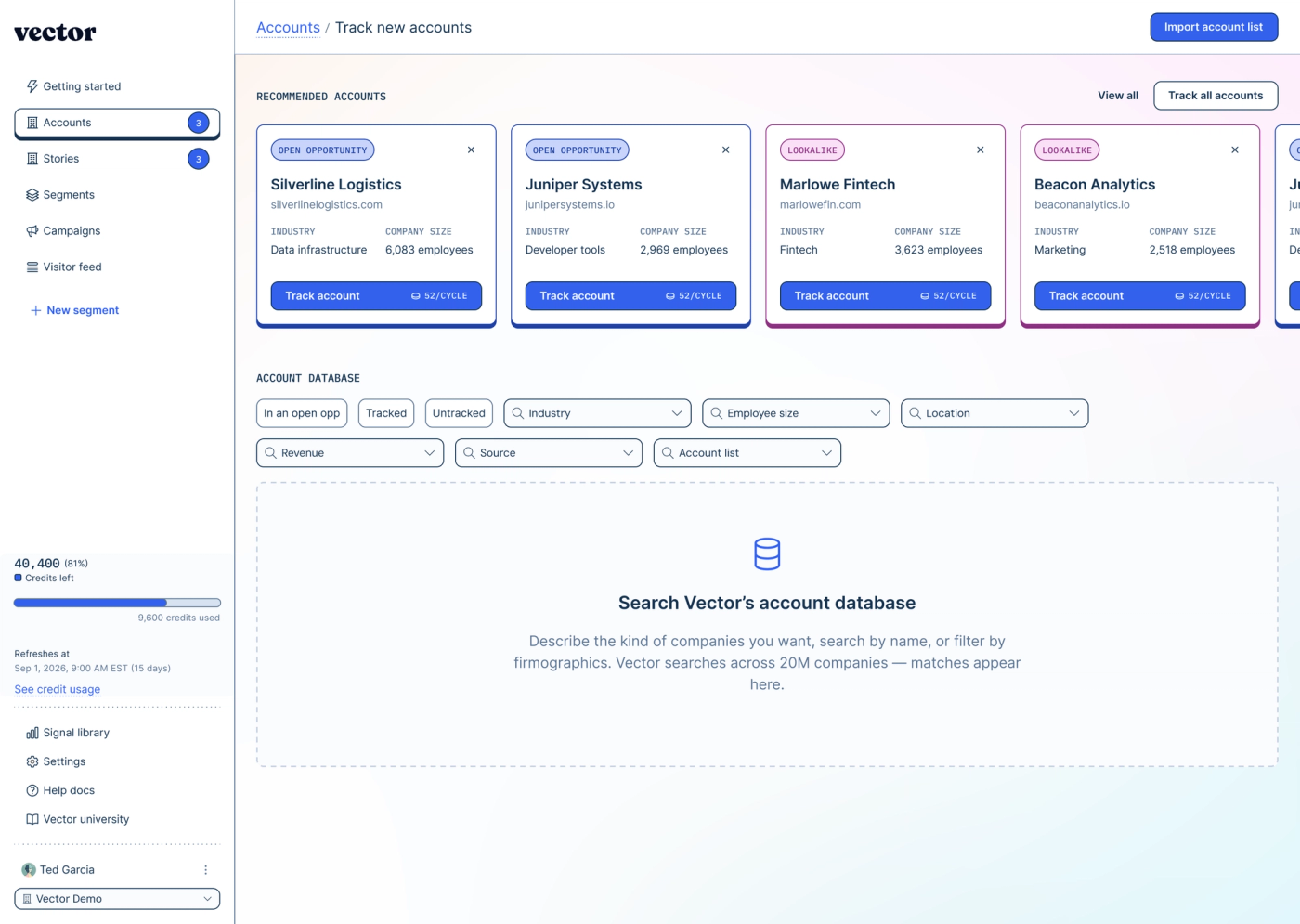
Tracked accounts are staged and ranked with the evidence behind each call, and the named contacts engaging at each one are attached wherever a real person has been identified. When account-level timing, committee engagement, and research activity converge on the same account, sales gets one handoff with the story of how the account got there. Audiences rebuild from that same data and sync to LinkedIn, Google, and Meta, so a promoted account is in the right audience the same day.
If your tiers were set at annual planning and haven't moved since, see how Vector handles ABM.
Frequently asked questions
What is one-to-one ABM?
One-to-one ABM is a plan built for a single target account, with named contacts mapped, messaging written for that company, and a rep who owns it. It's the most expensive level of effort per account, so it is reserved for the deals that justify it.
What is the difference between 1:1, 1:few, and 1:many ABM?
They are levels of tailored effort. One-to-one treats each account individually. One-to-few groups similar accounts and tailors messaging to the cluster and persona. One-to-many reaches the rest of the target list with programs that scale, such as ads to ICP-fit contacts.
How many accounts should be in Tier 1?
As many as your reps can work properly each week. Start from capacity and work backward. A Tier 1 list that is several times what sales can cover gets Tier 2 treatment in practice.
When should an account move up a tier?
When identified people at the account engage, especially on high-intent pages such as pricing, and especially when more than one person does so in the same couple of weeks. A change at the company plus committee engagement plus research activity in the same window is the strongest case.
How often should ABM tiers be reviewed?
Review account movement weekly, because engagement goes stale in weeks. Review the tiering model itself every six to twelve months against closed-won and closed-lost deals, and sooner if your product or positioning changes.