


One set of KPIs for a whole ABM program hides the place where accounts stall. An account you've only just identified and an account choosing between you and one competitor need different things from you, so they need different measures. Report them together and the average tells you the program is "fine" while half your target list sits in the same stage for a quarter.
The fix is to measure each buying stage on its own terms, using a KPI you can trace back to the signal that moved the account.
TL;DR
- Track ABM KPIs per buying stage: Identified, Aware, Interested, Considering, Selecting.
- Early stages are measured on coverage and reach. Later stages are measured on named engagement, meetings, and deals.
- Report regression as well as progression. Accounts go cold, and a stage report that only moves forward is hiding them.
- Every stage change should come with the evidence behind it, so sales can see why an account moved.
- Stage velocity, the time an account spends in each stage, shows where the program is stuck before pipeline does.
Why ABM KPIs belong to a stage
Most ABM reporting borrows its shape from the lead funnel: a few totals at the top, a conversion rate between each step, pipeline at the bottom. That works when every lead follows the same path. Target accounts don't. They're chosen before they've shown any interest, they move forward and backward, and several people inside each one are at different points at the same time.
A single program-level KPI, such as engaged accounts or influenced pipeline, blends all of that into one number. It can't tell you whether the problem is that you're not reaching the accounts, reaching them and getting no response, or getting a response and never booking the meeting. Each of those has a different fix.
Staging accounts separates the problems. The five stages below are the ones Vector uses, and the same sequence shows up in practitioner-built programs, including the modern ABM engine described in Growth Unhinged. The definitions here are a working version you can adapt. What matters is that every stage has its own question and its own KPI.
The KPIs for each buying stage
Identified: have you picked the right accounts and found the people?
An identified account fits your ICP and is on the list. Nothing has happened yet. At this stage you're measuring the quality of the list itself.
- ICP fit, tested against closed-won. Do the accounts on the list look like the customers you've won and kept? Re-test the list against won and lost deals on a regular schedule, because the profile drifts.
- Contact coverage. The share of identified accounts where you have named contacts on the likely buying committee. An account with no contacts can't progress.
If an account sits in Identified for months, the usual cause is thin contact data, and more ad spend won't fix it.
Aware: are you reaching the account?
An aware account has been exposed to you. Your ads have been served to people there, or something has changed in the account's world that makes your message timely: a funding round, a leadership change, hiring for the role you sell to.
- Reach into the committee. The share of named contacts at the account who've been served an ad.
- Account-level ad response. Whether the account shows up in your ad engagement data at all.
Treat company-level activity as evidence about timing. It tells you the account is in motion. It doesn't tell you a buyer raised a hand, and reporting it as engagement is how dashboards end up overstating progress.
Interested: has a real person responded?
This is the first stage that requires an identified human. Someone at the account visited the site, clicked an ad, reacted to a post, or replied to an email, and you know who.
- Named contacts engaged per account. One is a start. The number you want to see rising is the count of different people.
- Cost per engaged contact. Spend divided by identified contacts who engaged. This is where ad efficiency starts to be measurable in a way finance will accept.
Considering: is a buying committee forming?
Several people at the account are now researching, and the pages they visit have changed. Pricing, integrations, security, and comparison content replace blog posts.
- Buying-committee coverage. Of the roles that have to approve the purchase, how many are engaged? Enterprise committees often include six to eleven people, so one champion isn't coverage.
- Meetings per target account. Booked meetings with named contacts. This is the KPI sales will credit.
- Signal-to-touch time. How quickly a high-intent signal is followed by an ad or outreach. Interest at this stage fades in days.
An account that reaches Considering and stops is usually a handoff problem. The signal arrived and nobody acted on it, which is worth tracking as its own number.
Selecting: is it becoming a deal?
There's an open opportunity and the account is choosing. Marketing's job changes from creating interest to supporting the deal, and the KPIs change with it.
- Stage-to-opportunity conversion. The share of Considering accounts that open an opportunity.
- Influenced pipeline, with named touches. The opportunities where marketing reached the committee, with contacts and dates attached.
- Win rate, touched versus untouched. Whether deals where the committee saw your ads close more often than similar deals where it didn't.
Two KPIs that cut across every stage
Progression and regression. Count the accounts that moved forward this month and the ones that moved back. Signals decay. A change in the account's circumstances stays relevant for months, and a person's engagement goes stale in weeks. An account that was Considering in the spring and has been silent since belongs in an earlier stage, and your report should say so.
Stage velocity. The median number of days accounts spend in each stage. When velocity slows in one stage, you've found the constraint. It shows up in this number a quarter before it shows up in pipeline.
Together they turn a static stage count into something you can act on: which accounts to promote, which to rest, and which stage needs a different play.
Make every stage change explainable
A stage is only as useful as sales' willingness to believe it. If a rep is told an account moved to Considering and can't see why, the stage becomes another score to argue with, and we've written before about what account scoring gets wrong when the person behind the signal disappears.
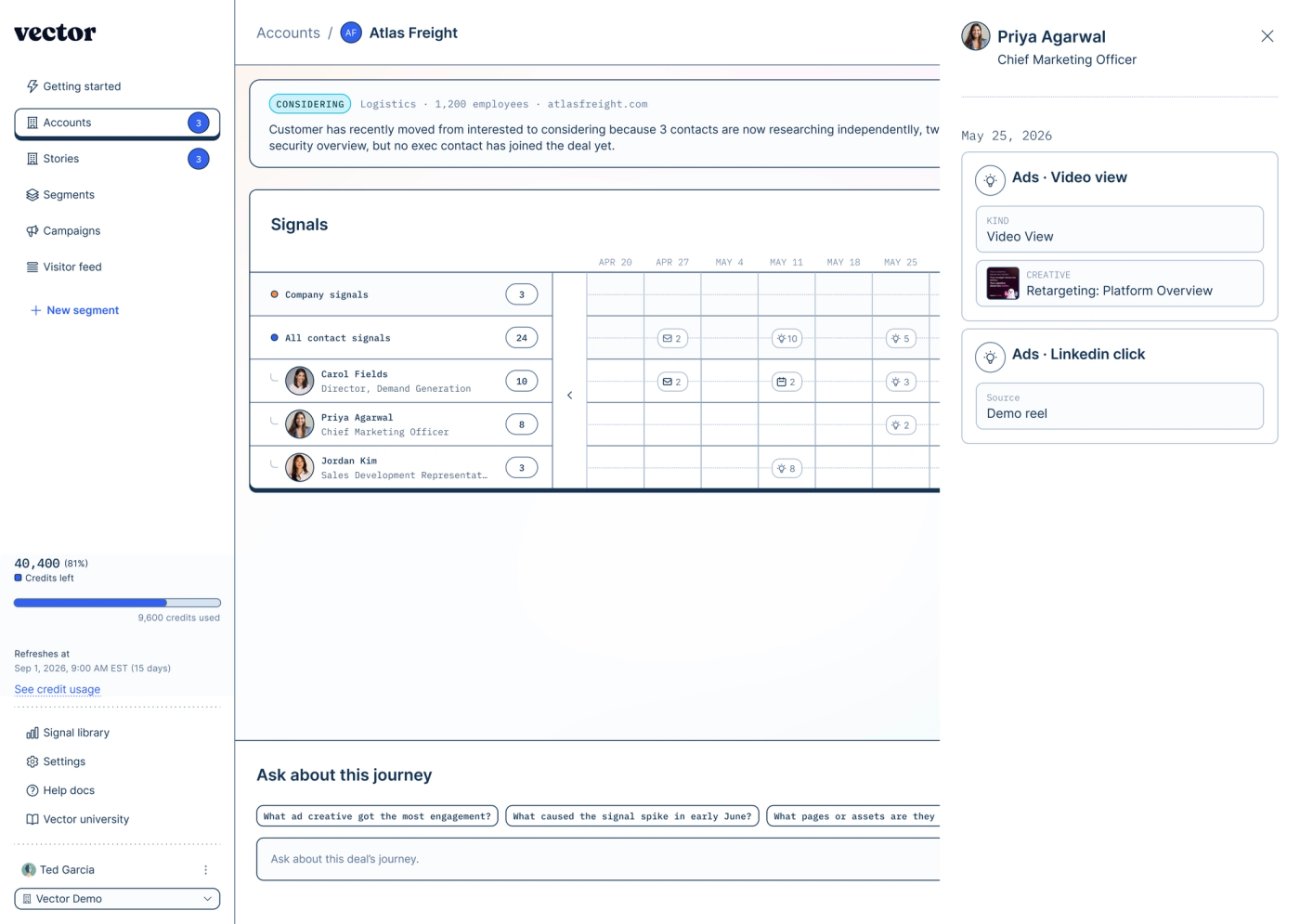
So attach the evidence to the move. "Three contacts are researching independently, two visited pricing this week, and no executive has joined yet" is something a rep can act on. It names who to reach and points at who's missing.
How Vector stages accounts
Vector stages every tracked account from Identified through Selecting and ranks them. Each stage shows the evidence behind the call, so nobody has to take a score on trust.
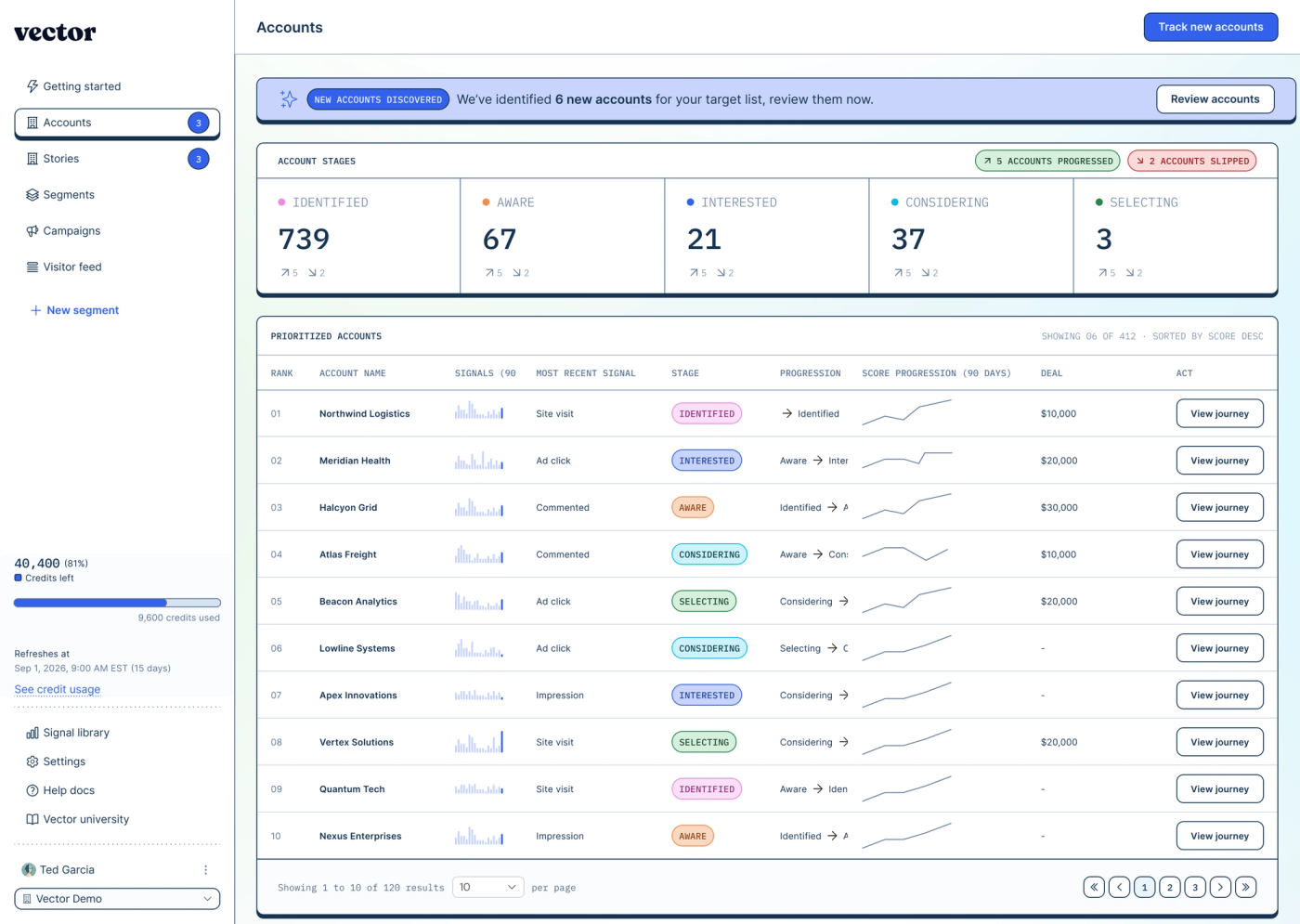
Open any account and the timeline shows the signals behind its stage, in order, with named contacts attached wherever a real person has been identified. People only appear when they've been confidently resolved, which means you'll see fewer names than a visitor-identification tool shows you, and you can stand behind every one.
From there, a stage can become an audience. Build a segment from the accounts in Considering and the ads follow the stage as accounts move in and out of it.
If your ABM report shows totals and can't show where accounts are stuck, see how Vector handles ABM.
Frequently asked questions
What are ABM KPIs?
ABM KPIs are the measures you use to judge whether an account-based marketing program is working. The most useful ones are tied to a buying stage, such as contact coverage for newly identified accounts and meetings per target account for accounts that are actively considering.
What are the stages of an ABM program?
A common model uses five: Identified, Aware, Interested, Considering, and Selecting. Accounts start as a fit on a list, become aware as they are reached, show interest when a named person engages, consider when a committee forms, and select when an opportunity is open.
Which KPI matters most at each ABM stage?
Contact coverage at Identified, reach into the committee at Aware, named contacts engaged at Interested, meetings per target account at Considering, and win rate against untouched deals at Selecting. Each one answers the question that stage raises.
What is stage velocity in ABM?
Stage velocity is the median time accounts spend in a stage before moving on. When it slows in one stage, that stage is the constraint. It shows up in velocity well before it shows up in pipeline.
Should ABM reports show accounts that move backward?
Yes. Engagement goes stale within weeks and accounts go quiet. A report that only counts progression overstates the program and keeps cold accounts in stages they no longer belong in.