
Guide
The signal-to-meeting playbook for ABM
How to go from raw signals to booked meetings without losing your sales team along the way.


Author
The Vector team
Featuring insights from

Kevin Driscoll
Head of Global ABM & Campaigns, Datadog
This playbook is built from a conversation with Kevin about how he approaches enterprise ABM, from signal strategy to sales handoff to measurement. We took his framework and turned it into a step-by-step guide for any team looking to run a tighter ABM program. Before Datadog, Kevin held demand gen and growth marketing roles at Anaplan and IBM.

Connect with Kevin on LinkedIn
Overview
ABM has a dirty secret. Most programs look incredible in the strategy deck and then quietly underdeliver once they're live.
The accounts are selected, the channels are mapped, the budget is approved... and then sales ignores the whole thing because it's too complicated to use.
The strategy is rarely the problem. The operating system underneath it is.Here's what you should know about getting it right.
Account selection should involve sales, not just data
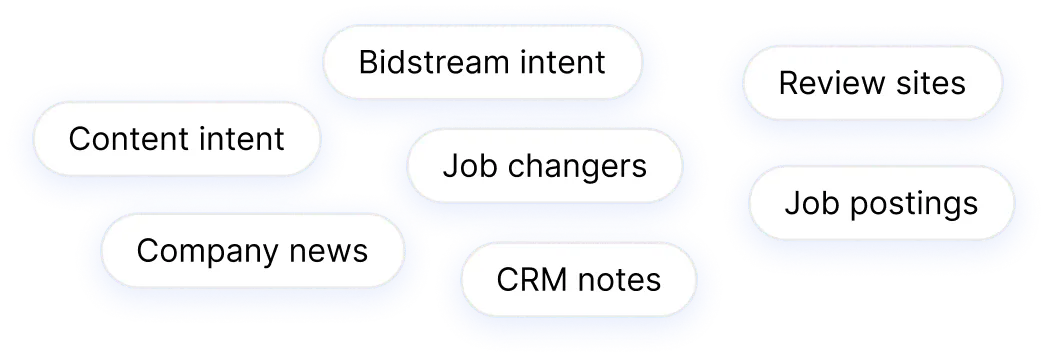
Spend real time on setup. A few weeks of research before a cycle launches is worth it. Layer on signal data from as many sources as you can. Job postings, content intent, bidstream intent, CRM notes, news, review site activity. Weight them differently based on what you've tested, then generate an account score.
But don't let the score be the only input. Rep buy-in matters just as much.If a rep doesn't believe in an account or doesn't want to work it, no amount of signal data is going to make that engagement productive.
The accounts that perform best are the ones where the data says “this is a good target” and the rep says “I want to work this one.”
That combination keeps the program from becoming marketing talking to itself.
Once you've selected your accounts, commit to them for six to nine months. Run a focused campaign, capture demand where it exists, try to generate it where it doesn't. If an account isn't showing signs of life after that window, rotate it out and bring in a new batch.
Most ABM programs fail between strategy and execution. Here's the operating system that connects each stage.
Hoard signals, then test ruthlessly
The signal data you use to select accounts shouldn't stop at selection. Keep it running throughout the campaign, and cast a wider net than you think you need.
This is especially true for global programs. If you're running ABM across EMEA and APAC, data quality on any single source is inconsistent. LinkedIn isn't the primary professional platform everywhere. If your signal stack is narrow, entire regions go dark.
Don't pick two signal sources and build your whole strategy around them. Cast a wide net, test ruthlessly, and let the data tell you what works.
If these outperform when targeted, the signal is real.
If performance is flat, the signal is noise.
Flat performance means it's background data.
The key is that hoarding isn't the same as acting on everything blindly. You collect broadly, then you test. Compare accounts that flag for a specific signal against accounts that don't. If the signal-flagged accounts outperform when you target them, the signal is real. If performance is flat, it's noise. Over time, you learn which signals to weight heavily and which ones are just background data.
Bidstream intent tends to be inconsistent. Job changers are only useful when the person moving into the account is a heavy product user, not just any new hire at any level. The signals that consistently move the needle are the ones tied directly to the problem your product solves. Which brings us to one of the most useful concepts in signal strategy…
Find your alpha signal
Don't pick two signal sources and build your whole strategy around them. Cast a wide net, test ruthlessly, and let the data tell you what works.
When every vendor in your space is sending the same “congrats on the new role” email triggered by the same job changer data, nobody gets noticed.
An alpha signal is an event or data point that is specific to what you sell and hard for your competitors to replicate. Two ways to think about it:
If you sell reliability or monitoring software, service outage reports on Downdetector or Reddit are gold. But timing matters. Don't reach out during the incident. That's ambulance chasing and it will burn the relationship. Wait a couple weeks, after the postmortem, when the pain is still fresh and the team is thinking about prevention.
Everyone has access to hiring data. But if your product serves data infrastructure teams, a spike in Snowflake-related job postings at a target account tells you something specific: their data estate is growing, and that's when infrastructure decisions get made.
The principle applies regardless of what you sell. Find the signal that's specific to your product's value and that your competitors can't easily replicate.
The shift is from "I saw you're hiring" to "you've added 50% more data engineers this year, which usually means your infrastructure complexity is scaling fast. Am I reading that right?"
Build micro plays inside your broader campaign
The campaign itself is the container. Inside it, build signal-triggered micro plays that fire based on what's happening in specific accounts.
Job changers coming in from customer accounts or similar companies might get a “first 90 days” package. Accounts showing signs of infrastructure strain might get messaging around complexity and scale. Accounts with recent public incidents might get a sequence focused on prevention and visibility.
Each micro play should have its own targeting, messaging, and timing. This is what makes ABM feel personalized at scale instead of one-size-fits-all. The broad campaign keeps accounts warm with consistent impressions. The micro plays create moments of relevance when something specific happens. Both matter, but the micro plays drive real meetings.
Make the sales handoff stupidly simple
Here's where most ABM programs fall short. Marketing builds a sophisticated signal engine and then asks sales to log into another dashboard to see the output.
Don't do this. The number one complaint sales teams have about ABM programs is some version of:
"I have too many tools. Do not add another one."
Instead, collapse everything into the simplest delivery mechanism possible. Take your signal data, your marketing leads, your sales-owned contacts, and run them all through a scoring model. Then send each rep a weekly email with their top 15 contacts to reach out to.
Load all the context into an AI model rather than a briefing doc. When the rep goes to write outreach, the AI handles the personalization. The rep gets a name, a score, and a model that knows the account.
The first feedback you want from sales doesn't have to be “this is working.” “This is simple” is enough. If reps can understand what they're looking at and act on it quickly, the results will follow.
The result, when it works, is true orchestration. You can verify that outbound is hitting the same people you're targeting with digital advertising, email, and direct mail. That alignment is what makes surround sound ABM truly work instead of being a buzzword.
Use contact-based marketing to close the reach gap
All of the above only works if you can reach the actual people you've identified across channels.
If you're running ABM through LinkedIn alone, you're going to find that a meaningful percentage of your target accounts have zero ad penetration. A lot of B2B buyers, especially technical ones, aren't active on LinkedIn. They log in twice a year to post a promotion and disappear. They're watching YouTube, searching Google, scrolling Reels.
And even for people who are on LinkedIn, the native targeting is imperfect. You can stack every filter available and still get irrelevant people in your audience. You need to be marketing to individuals, not title sets, because the ad platforms can't get title-based targeting right on their own.
Contact-based marketing solves this by letting you take your scored contact lists and push them as matched audiences across LinkedIn, Google, Meta, YouTube, and wherever else your buyers spend time. Instead of relying on each platform's native targeting, you bring your own audience. That's how you guarantee real impressions on the people who matter, even on channels that were never built for B2B.
Contact-based ads create a self-reinforcing loop between your advertising, your website, and your sales team's outbound.
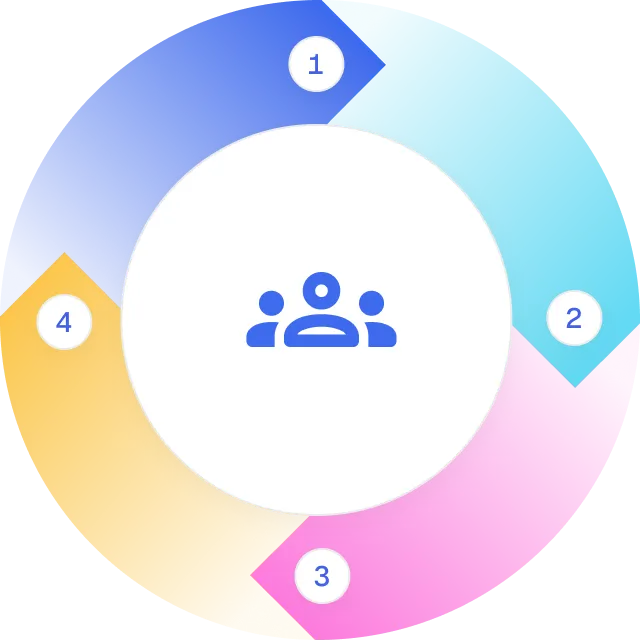
Push scored contact lists as matched audiences across LinkedIn, Google, Meta, and YouTube.
You're not hoping the right people show up — you're sending them there.
See who those visitors are by name — the actual person, not just the company.
Visitors get scored, prioritized, and handed to reps the following week.
Measure with meetings, not pipeline
Pipeline is the goal, but it's a terrible metric for optimizing an ABM program in real time. By the time you see pipe, the campaign that influenced it ended months ago.
MQLs are too noisy. Sales doesn't trust them and honestly neither should you.
Meetings sit in the sweet spot. They're fast enough to get signal within weeks. They're credible enough that sales respects them as a real number. And deals don't get created without meetings. The act of sitting down with multiple people in an account forces the rep to refine their hypothesis about the account, which leads to better messaging, which leads to more meetings. It's a flywheel.
In Kevin's experience:
Those are program-level numbers, and that's intentional. With this many moving parts, trying to isolate the impact of individual channels is a fool's errand. The comparison that matters is your ABM cohort vs. a control group of similar accounts. If the ABM accounts are booking significantly more meetings and generating more pipeline, the program is working.
For budgeting, a good rule of thumb is to target a 5:1 pipeline-to-spend ratio. With a ~20% close rate, that returns roughly $1 in bookings for every $1 spent. Map out that waterfall for your own close rates and deal sizes, and you'll know how much budget you need and how many accounts you can realistically take on.
Start manual, scale with proof
Whatever you do, don't build the full program first. Don't stand up advertising, microsites, events, direct mail, and outbound simultaneously. That's a quick recipe for burning budget before you've proven anything.
Start by talking to sales. Figure out what's broken for them. Maybe they can't get meetings with the broader buying group. Maybe they can't crack a specific region. Maybe they just need better contact data for accounts they already care about.
Solve that one pain point—manually if you have to. Do direct mail by hand. Pull contact lists from the CRM and load them into LinkedIn campaigns yourself. Write outbound sequences for your top accounts. If it works, you'll have the proof you need to invest in software and headcount to scale it.
Find two or three reps who are willing to partner with you. Run the plays by hand. Show the results. The software and the budget will follow the proof.
Ready to close the reach gap?
Vector is a contact-based marketing platform that helps B2B teams run the kind of playbook described above.